Raw for Maximum Nutrition

Made in our own Kitchens

Human grade products

Raw for Maximum Nutrition

Made in our own kitchens

Human grade products

11 May 2026

Feeding a Persian Cat in India: The Complete Vet- Backed Diet Guide (2026 Edition)

Feeding a Persian cat in India? Get vet-backed grams/day charts, ₹/month costs, food comparisons, and a 4-week kibble-to-fresh transition plan. Updated 2026.

A fluffy gray Persian cat with bright yellow eyes is lying on a white background, looking directly at the camera.

11 May 2026

Feeding a Persian Cat in India: The Complete Vet- Backed Diet Guide (2026 Edition)

Feeding a Persian cat in India? Get vet-backed grams/day charts, ₹/month costs, food comparisons, and a 4-week kibble-to-fresh transition plan. Updated 2026.

A fluffy gray Persian cat with bright yellow eyes is lying on a white background, looking directly at the camera.

Feeding a Persian cat in India requires more than picking the bag with the breed name on it. India's 40°C summers, cold-chain gaps in tier-2 cities, and the wide price gap between kibble and fresh food all shift the answer. Add the Persian's flat skull, long coat, and genetic vulnerability to kidney and urinary disease - and the standard approach falls short fast. This guide covers everything.

Why Feeding a Persian Cat depends on their Biology as this Defines Their Feeding Needs

The Brachycephalic Skull and the Kibble Problem

The Persian's flat, compressed skull changes how the cat picks up food. Standard kibble shapes sit awkwardly in a brachycephalic jaw. Many Persians cannot bite down effectively, so they swallow pieces whole. Whole kibble means slower gastric emptying, more vomiting, and more hairball build-up. Ground or chopped raw, gently cooked, or wet food avoids the problem entirely. That is the mechanical issue. The nutritional issue runs deeper - and it starts with the coat.

The Long Coat's Nutritional Demands

The Persian coat is a single layer of fine, long fur. Building it requires animal-source fatty acids and amino acids every day. Without omega-3 (EPA and DHA), arachidonic acid, biotin, and zinc - most bioavailable from raw or gently cooked meat and oily fish - the coat thins, dander rises, and shedding doubles. Heat-extruded kibble fats are degraded during processing. A Persian on kibble alone rarely gets enough of these nutrients in bioavailable form. Dullness, matting, and excess dandruff are diet signals before they are grooming problems.

Persian Cat Breed

Genetic Predispositions: FLUTD, PKD and IBD

Persians are clinically over-represented for three conditions: feline lower urinary tract disease (FLUTD), polycystic kidney disease (PKD), and inflammatory bowel disease (IBD). The biggest dietary lever for all three is moisture. Dry kibble delivers 8–10% moisture. A raw or wet diet delivers 65–75%. In India's 38–42°C summers, that gap becomes medically critical.

VETERINARY NOTE
Persians are obligate carnivores. They require arachidonic acid, taurine, and pre-formed vitamin A from animal sources - not plant ingredients. This is feline metabolic biochemistry, not opinion.

Feeding a Persian Cat in India - Chart, Costs and Food Types

Now to the practical side of feeding a Persian cat in India: how much to feed, what it costs in rupees, which food types perform best, and which Indian kitchen staples are quietly toxic.

Daily Feeding Chart - Kitten to Senior

The right amount depends on body weight, life stage, activity level, and food density. Below is a vet- reviewed starting framework for fresh, raw, or gently cooked diets. Reduce by 10–15% for dense commercial cooked formats. Never underfeed kittens or nursing queens. Adjust ±10% over two weeks based on body condition and reweigh monthly.

Daily Feeding Chart

HOW TO USE THIS CHART
Find your Persian's life stage and weight band. Take the mid-range of grams per day and split across recommended meals. You should be able to feel your cat's ribs without pressing hard, and see a visible waist from above. Consult your vet before deviating more than 15% from these ranges.

Persian Cat Food Cost in India - ₹/Month Breakdown

Most Indian Persian owners have no idea what their cat's food actually costs per day. Royal Canin Persian Adult retails around ₹1,200–₹1,400 per 400g, and a typical Persian needs about 60g/day - that works out to ₹180–₹210/day on kibble alone. A vet-formulated fresh diet from BARF India costs ₹65–₹95/day at 60–75% moisture.

Persian Cat Food Cost in India

The math surprises most owners. Switching from Royal Canin Persian to BARF India fresh food saves roughly ₹2,000–₹4,500 per month. Over 12 months, that is ₹24,000–₹54,000 saved - before counting avoided vet bills for urinary blockages and IBD flare-ups.

Purple label for Cooked Cat Food - Grain Free Chicken & Tuna Recipe (1.75kg | 7x250g) by www.barfindia.com. Features cat graphic, feeding guidelines, ingredients, safety info, and maker details. All-natural, preservative-free, family-owned brand.
An orange label for Cooked Cat Food – Grain-Free Buffalo & Chicken Recipe (1.75kg | 7x250g) from www.barfindia.com lists ingredients, feeding instructions, and safety info. A gray-striped cartoon cat stretches at the bottom left. Made in India.
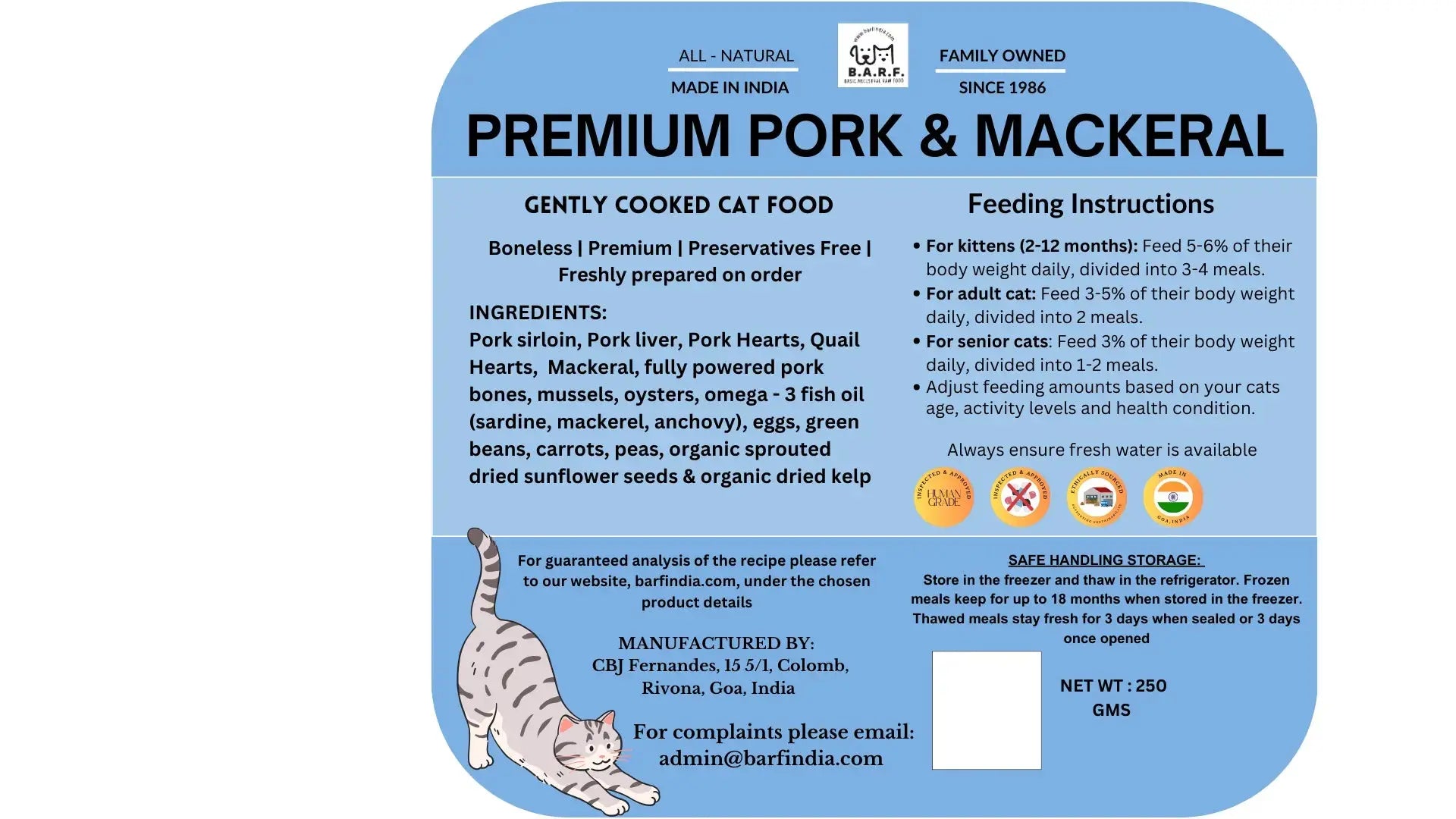
Blue label for Cooked Cat Food - Grain-free Mackerel & Pork Recipe (1.75 kg, 7x250g) by www.barfindia.com. High protein, with ingredients and feeding instructions. Gray striped cat illustration; yellow safety info box on right.
Cooked Cat Food - Grain free Rabbit & Quail Recipe (1.75kg, 7x250g) label features ingredients, feeding and storage instructions, allergy warnings, manufacturer info (www.barfindia.com), and a gray tabby cat illustration on a pink background.
Yellow label for Sampler Pack - Gently Cooked Cat Food by www.barfindia.com, highlighting all-natural, preservative-free boneless chicken. Includes a cartoon cat, feeding guide, ingredients, storage tips, manufacturer info, and 250g net weight.
An infographic for www.barfindia.com’s Sampler Pack - Gently Cooked Cat Food shows five steps—Protein, Prep Produce, Cold Combine, Pack & Freeze, Test/Ship/Enjoy—with brief descriptions and illustrated icons for each.
Purple label for Cooked Cat Food - Grain Free Chicken & Tuna Recipe (1.75kg | 7x250g) by www.barfindia.com. Features cat graphic, feeding guidelines, ingredients, safety info, and maker details. All-natural, preservative-free, family-owned brand.
An orange label for Cooked Cat Food – Grain-Free Buffalo & Chicken Recipe (1.75kg | 7x250g) from www.barfindia.com lists ingredients, feeding instructions, and safety info. A gray-striped cartoon cat stretches at the bottom left. Made in India.
Blue label for Cooked Cat Food - Grain-free Mackerel & Pork Recipe (1.75 kg, 7x250g) by www.barfindia.com. High protein, with ingredients and feeding instructions. Gray striped cat illustration; yellow safety info box on right.
Cooked Cat Food - Grain free Rabbit & Quail Recipe (1.75kg, 7x250g) label features ingredients, feeding and storage instructions, allergy warnings, manufacturer info (www.barfindia.com), and a gray tabby cat illustration on a pink background.
Yellow label for Sampler Pack - Gently Cooked Cat Food by www.barfindia.com, highlighting all-natural, preservative-free boneless chicken. Includes a cartoon cat, feeding guide, ingredients, storage tips, manufacturer info, and 250g net weight.
An infographic for www.barfindia.com’s Sampler Pack - Gently Cooked Cat Food shows five steps—Protein, Prep Produce, Cold Combine, Pack & Freeze, Test/Ship/Enjoy—with brief descriptions and illustrated icons for each.

Sampler Pack - Gently Cooked Cat Food

Rs. 320.00
An orange label for Cooked Cat Food – Grain-Free Buffalo & Chicken Recipe (1.75kg | 7x250g) from www.barfindia.com lists ingredients, feeding instructions, and safety info. A gray-striped cartoon cat stretches at the bottom left. Made in India.
An infographic shows 5 safe steps for prepping Cooked Cat Food – Grain-Free Buffalo & Chicken Recipe (1.75kg | 7x250g) by www.barfindia.com: steam/thaw protein, wash/steam produce, cold combine, pack/freeze, test/ship/enjoy!.
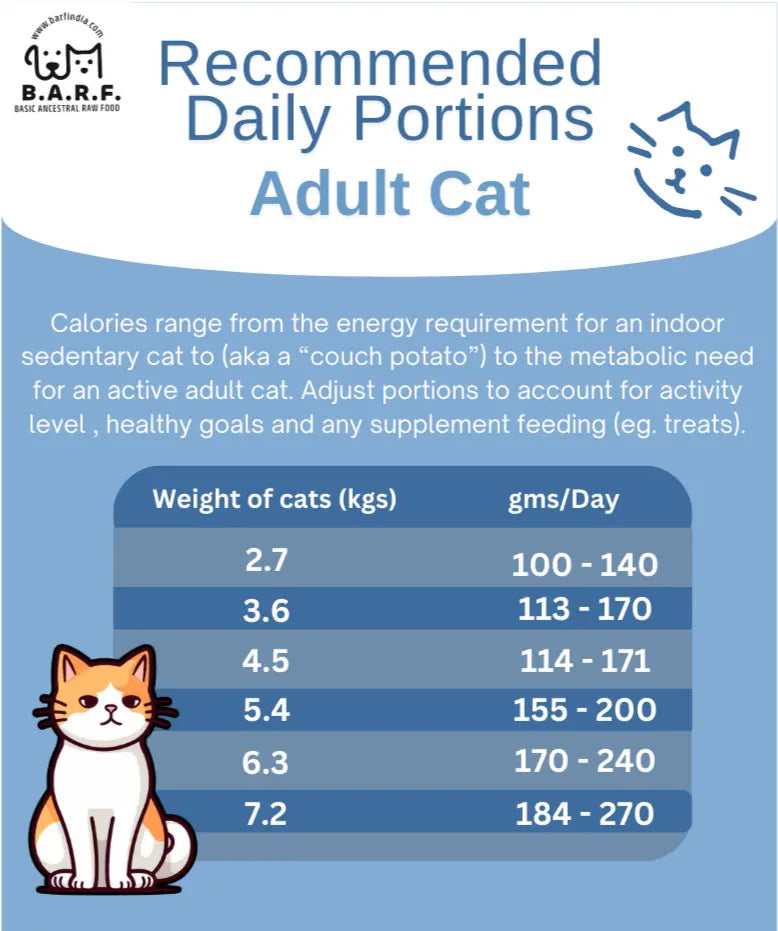
Infographic displays daily portions for adult cats (2.7–7.2 kg) in grams/day for Cooked Cat Food – Grain-Free Buffalo & Chicken Recipe (1.75kg | 7x250g) by www.barfindia.com, with a cartoon cat and tips to adjust food for activity and treats.
Infographic for Cooked Cat Food – Grain-Free Buffalo & Chicken Recipe (1.75kg) from www.barfindia.com: Holistic vet-crafted, high-protein, 87% chicken, liver, eggs, mussels & oysters with veggies and healthy fats. Small batch made.
An orange label for Cooked Cat Food – Grain-Free Buffalo & Chicken Recipe (1.75kg | 7x250g) from www.barfindia.com lists ingredients, feeding instructions, and safety info. A gray-striped cartoon cat stretches at the bottom left. Made in India.
An infographic shows 5 safe steps for prepping Cooked Cat Food – Grain-Free Buffalo & Chicken Recipe (1.75kg | 7x250g) by www.barfindia.com: steam/thaw protein, wash/steam produce, cold combine, pack/freeze, test/ship/enjoy!.
Infographic displays daily portions for adult cats (2.7–7.2 kg) in grams/day for Cooked Cat Food – Grain-Free Buffalo & Chicken Recipe (1.75kg | 7x250g) by www.barfindia.com, with a cartoon cat and tips to adjust food for activity and treats.
Infographic for Cooked Cat Food – Grain-Free Buffalo & Chicken Recipe (1.75kg) from www.barfindia.com: Holistic vet-crafted, high-protein, 87% chicken, liver, eggs, mussels & oysters with veggies and healthy fats. Small batch made.

Cooked Cat Food – Grain-Free Buffalo & Chicken Recipe (1.75kg | 7x250g)

Rs. 2,100.00
Purple label for Cooked Cat Food - Grain Free Chicken & Tuna Recipe (1.75kg | 7x250g) by www.barfindia.com. Features cat graphic, feeding guidelines, ingredients, safety info, and maker details. All-natural, preservative-free, family-owned brand.
Infographic for Cooked Cat Food - Grain Free Chicken & Tuna Recipe (1.75kg, 7x250g) by www.barfindia.com: Pie chart—87% meat & seafood, 9% fats/seeds/root veggies, 4% dark green veggies. Small batch, gently cooked, human-grade ingredients.
Purple label for Cooked Cat Food - Grain Free Chicken & Tuna Recipe (1.75kg | 7x250g) by www.barfindia.com. Features cat graphic, feeding guidelines, ingredients, safety info, and maker details. All-natural, preservative-free, family-owned brand.
Infographic for Cooked Cat Food - Grain Free Chicken & Tuna Recipe (1.75kg, 7x250g) by www.barfindia.com: Pie chart—87% meat & seafood, 9% fats/seeds/root veggies, 4% dark green veggies. Small batch, gently cooked, human-grade ingredients.

Cooked Cat Food - Grain Free Chicken & Tuna Recipe. 1.75kg | 7x250g

Rs. 1,995.00
A bright yellow
Infographic for Cooked Cat Food - Grain Free Chicken Recipe (1.75kg) by www.barfindia.com: 87% chicken, liver, eggs, mussels & oysters; 9% healthy fats, seeds & root veggies; 4% dark green veggies. Circular chart on yellow background.
Chart shows daily food portions (grams) for adult cats (2.7–7.2kg) for Cooked Cat Food - Grain Free Chicken Recipe by www.barfindia.com. Includes guidance, cartoon cat, and note to adjust for activity and treats. Pack: 1.75kg (7x250g).
Discover how www.barfindia.com's Cooked Cat Food - Grain Free Chicken Recipe (1.75kg, 7x250g) is made in five steps: select protein, prep produce, combine cold, pack & freeze, test & ship! Includes grain-free tips and vivid illustrations for each stage.
A plate with chicken breast, hearts, liver, mussels, shrimp, kidney, oysters, organic egg, and a creamy mix—each labeled as www.barfindia.com Cooked Cat Food - Grain Free Chicken Recipe ingredients.
A bright yellow
Infographic for Cooked Cat Food - Grain Free Chicken Recipe (1.75kg) by www.barfindia.com: 87% chicken, liver, eggs, mussels & oysters; 9% healthy fats, seeds & root veggies; 4% dark green veggies. Circular chart on yellow background.
Chart shows daily food portions (grams) for adult cats (2.7–7.2kg) for Cooked Cat Food - Grain Free Chicken Recipe by www.barfindia.com. Includes guidance, cartoon cat, and note to adjust for activity and treats. Pack: 1.75kg (7x250g).
Discover how www.barfindia.com's Cooked Cat Food - Grain Free Chicken Recipe (1.75kg, 7x250g) is made in five steps: select protein, prep produce, combine cold, pack & freeze, test & ship! Includes grain-free tips and vivid illustrations for each stage.
A plate with chicken breast, hearts, liver, mussels, shrimp, kidney, oysters, organic egg, and a creamy mix—each labeled as www.barfindia.com Cooked Cat Food - Grain Free Chicken Recipe ingredients.

Cooked Cat Food - Grain Free Chicken Recipe - 1.75kg (7x250g)

Rs. 1,780.00
Blue label for Cooked Cat Food - Grain-free Mackerel & Pork Recipe (1.75 kg, 7x250g) by www.barfindia.com. High protein, with ingredients and feeding instructions. Gray striped cat illustration; yellow safety info box on right.
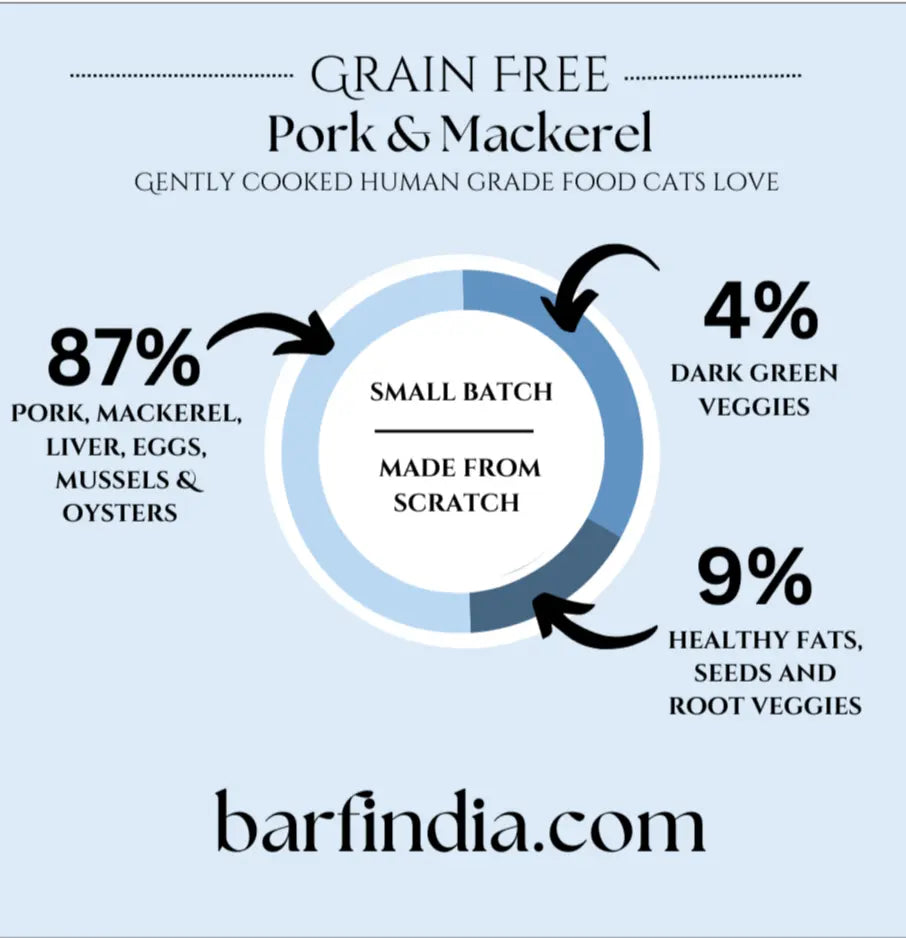
A circular infographic features www.barfindia.com’s Cooked Cat Food - Grain-free Mackerel & Pork Recipe: 87% pork, mackerel & organs; 4% dark green veggies; 9% healthy fats, seeds & roots—ideal for raw feeding. Pack: 1.75 kg (7x250g).
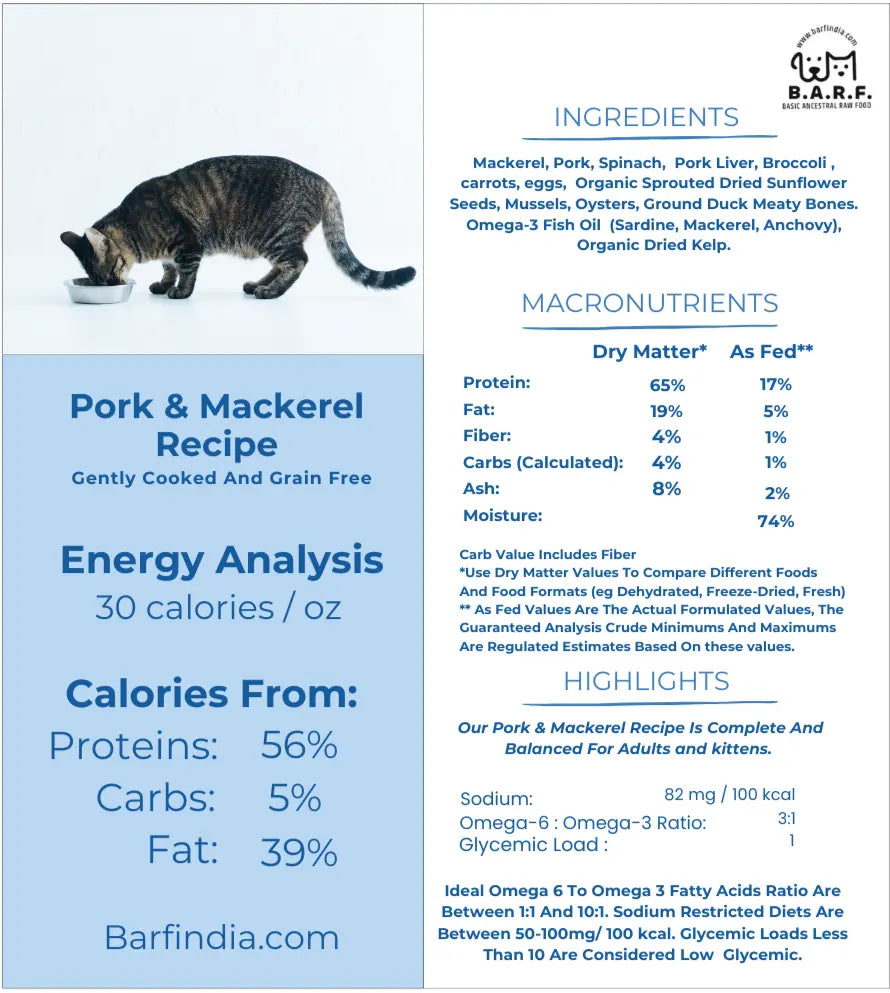
Nutrition details for www.barfindia.com's Cooked Cat Food - Grain-free Mackerel & Pork Recipe (1.75 kg), including ingredients such as pork, mackerel, and spinach; macronutrient content, calorie sources, energy analysis, and omega-6/omega-3 ratio.
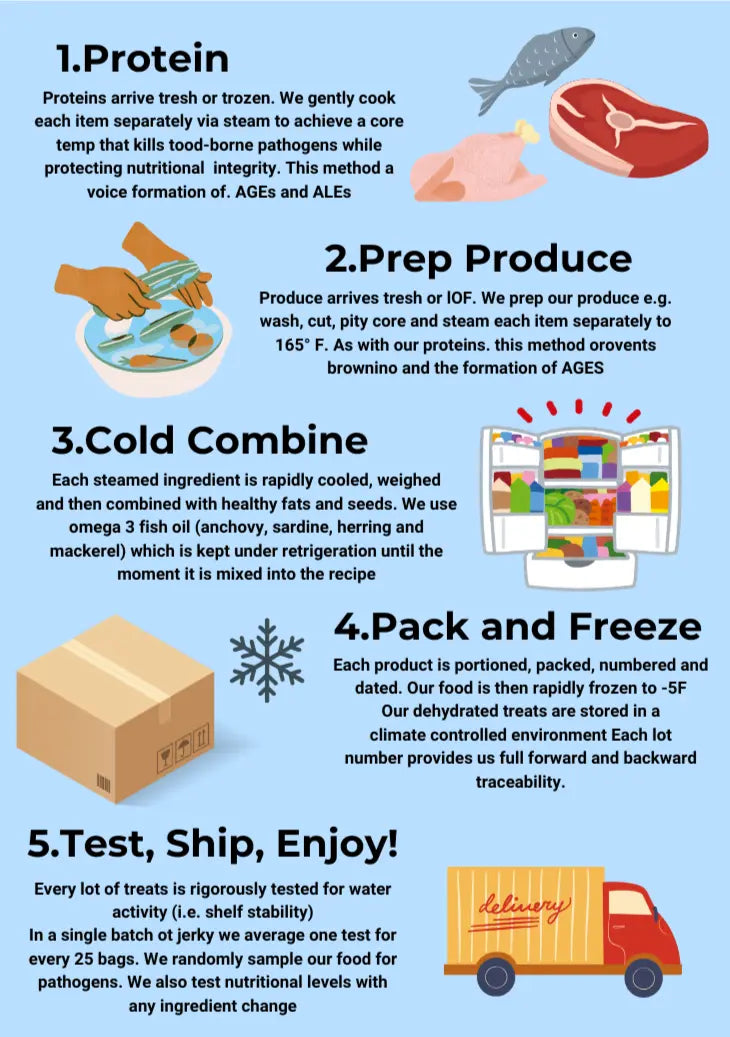
Infographic: How to prepare www.barfindia.com Cooked Cat Food - Grain-free Mackerel & Pork Recipe (1.75 kg)—steam/freeze protein, prep produce, mix with omega-3 oil, portion and freeze, then test before serving your cat.
Infographic shows daily portion ranges of Cooked Cat Food - Grain-free Mackerel & Pork Recipe by www.barfindia.com for adult cats from 2.7kg to 7.2kg, with cartoon cat and high-protein feeding advice. Pack: 1.75kg (7x250g).
Blue label for Cooked Cat Food - Grain-free Mackerel & Pork Recipe (1.75 kg, 7x250g) by www.barfindia.com. High protein, with ingredients and feeding instructions. Gray striped cat illustration; yellow safety info box on right.
A circular infographic features www.barfindia.com’s Cooked Cat Food - Grain-free Mackerel & Pork Recipe: 87% pork, mackerel & organs; 4% dark green veggies; 9% healthy fats, seeds & roots—ideal for raw feeding. Pack: 1.75 kg (7x250g).
Nutrition details for www.barfindia.com's Cooked Cat Food - Grain-free Mackerel & Pork Recipe (1.75 kg), including ingredients such as pork, mackerel, and spinach; macronutrient content, calorie sources, energy analysis, and omega-6/omega-3 ratio.
Infographic: How to prepare www.barfindia.com Cooked Cat Food - Grain-free Mackerel & Pork Recipe (1.75 kg)—steam/freeze protein, prep produce, mix with omega-3 oil, portion and freeze, then test before serving your cat.
Infographic shows daily portion ranges of Cooked Cat Food - Grain-free Mackerel & Pork Recipe by www.barfindia.com for adult cats from 2.7kg to 7.2kg, with cartoon cat and high-protein feeding advice. Pack: 1.75kg (7x250g).

Cooked Cat Food - Grain-free Mackerel & Pork Recipe - 1.75 kg (7x250g)

Rs. 1,950.00
Cooked Cat Food - Grain free Rabbit & Quail Recipe (1.75kg, 7x250g) label features ingredients, feeding and storage instructions, allergy warnings, manufacturer info (www.barfindia.com), and a gray tabby cat illustration on a pink background.
Discover our Cooked Cat Food - Grain free Rabbit & Quail Recipe (1.75kg) by www.barfindia.com: 87% rabbit, quail, liver, eggs, mussels & oysters; small batch cooked for complete cat nutrition.
An infographic titled “Recommended Daily Portions: Adult Cat” displays daily amounts of Cooked Cat Food - Grain Free Rabbit & Quail Recipe (1.75kg, 7x250g) for cats from 2.7kg to 7.2kg, with tips on activity and supplement adjustments from www.barfindia.com.
A colorful infographic from www.barfindia.com shows the 5-step process of making Cooked Cat Food - Grain free Rabbit & Quail Recipe (1.75kg): protein cooking, prepping produce, cold combining, packing/freezing, then testing and delivery.
Cooked Cat Food - Grain free Rabbit & Quail Recipe (1.75kg, 7x250g) label features ingredients, feeding and storage instructions, allergy warnings, manufacturer info (www.barfindia.com), and a gray tabby cat illustration on a pink background.
Discover our Cooked Cat Food - Grain free Rabbit & Quail Recipe (1.75kg) by www.barfindia.com: 87% rabbit, quail, liver, eggs, mussels & oysters; small batch cooked for complete cat nutrition.
An infographic titled “Recommended Daily Portions: Adult Cat” displays daily amounts of Cooked Cat Food - Grain Free Rabbit & Quail Recipe (1.75kg, 7x250g) for cats from 2.7kg to 7.2kg, with tips on activity and supplement adjustments from www.barfindia.com.
A colorful infographic from www.barfindia.com shows the 5-step process of making Cooked Cat Food - Grain free Rabbit & Quail Recipe (1.75kg): protein cooking, prepping produce, cold combining, packing/freezing, then testing and delivery.

Cooked Cat Food - Grain free Rabbit & Quail Recipe – 1.75kg (7x250g)

Rs. 2,350.00

Raw vs Cooked vs Wet vs Kibble - Which Is Best?

Every Indian Persian owner asks which food type is best. The honest answer sits on a spectrum: the closer to ancestral prey, the better the Persian responds clinically. Here is the decision tree for the four main formats available in India.

Raw (BARF / Prey-Model): Best for Persians of any age in good health - especially those with hairballs, dull coat, recurring UTI, or mild IBD. Requires cold-chain delivery and overnight fridge- thawing. BARF India ships frozen across most Indian metros.

Gently Cooked: Best for households uncomfortable with raw, or with young children or immuno- compromised members. Retains 60–70% moisture and most nutritional benefit. Small loss of heat- sensitive nutrients is supplemented in commercial formulas.

Wet Food (Pouches / Cans): Better than kibble for moisture (70–80%). Typically retort-sterilised at high heat. Many Indian wet pouches are 70–80% gravy and only 20–30% animal protein. Expensive at ₹250–₹400/day.

Premium Kibble (Royal Canin Persian, Hill's): Useful for travel or emergency back-up. Breed-shaped pieces help Persians grasp food. But 8–10% moisture and 30–40% carbs make it a poor long-term daily staple for Persian-specific conditions.

Persian Cat Breed

Foods to Never Give a Persian Cat - Indian Kitchen Edition

Indian households share food with pets far more than most Western ones. Sambhar leftovers, biryani scraps, and evening chai biscuits are common offerings. Several everyday Indian kitchen items range from mildly harmful to acutely toxic for Persians. The table below covers the most frequent mistakes.

Foods to Never Give a Persian Cat

Health and Transitions

Persian Coat Health - The Omega-3 and Hydration Link

Persian coats shed, mat, and develop dandruff - often because of what is in the food bowl, not a grooming problem. The single-layer coat is biochemically expensive. Each strand requires animal- source omega-3 (EPA and DHA) and arachidonic acid every day. Kibble fats are heat-degraded. Combine that with 8–10% moisture in a 38°C summer and you get chronic dehydration, dull fur, and rising dander.

The coat response to switching to fresh food is one of the most consistent things Indian Persian owners report. Softer fur appears within 2–3 weeks. Reduced shedding follows at 4–6 weeks. Dander and scabby spots typically resolve by week 6–10. Coat colour in cream, blue, and tortoiseshell Persians often deepens visibly.

Kidney and Urinary Health in India's Climate

Polycystic kidney disease and FLUTD are over-represented in Persians. Diet is the single biggest modifiable variable. A Persian on dry kibble relies entirely on the water bowl - and Persians are notoriously poor self-regulators of water intake. The result is chronic mild dehydration: concentrated urine, slower kidney filtration, and higher risk of struvite crystal formation.

India's 38–42°C summers compound this significantly. A Persian's long coat reduces air circulation, raising water-loss rates. By July, the average kibble-fed Indian Persian is dehydrated enough that urine specific gravity climbs into crystal-formation territory. Moisture-rich fresh food is the simplest, most effective preventive step. Add multiple water bowls and a feline fountain for extra support.

NATURE HAS ALREADY GIVEN THE RECIPE. WE HAVE ONLY IMPLEMENTED ITPersian Cat Breed

Hairballs, IBD and Vomiting - Causes Most Owners Miss

Indian Persian owners are often told that weekly vomiting is normal for the breed. It is not normal. It is largely diet-driven. Persians on fresh diets show higher gut motility and faster transit. Fur passes through in stool rather than accumulating into hairballs. The reason is simple: fresh food does not expand in the stomach the way dry kibble does.

Inflammatory bowel disease is disproportionately diagnosed in Persians. Breeder data from decade- long programmes shows dramatic reduction in chronic intestinal inflammation when fresh diets replace processed kibble. Heat-denatured proteins in extruded kibble can act as novel antigens to the feline immune system. If your Persian vomits more than once a week, investigate the diet first.

Feeding Persian Kittens in India - Weaning to 12 Months

The first 12 months are the most metabolically important of a Persian's life. Skeletal frame, dentition, immune programming, and lifelong gut microbiome all form in this window. Underfeeding, overfeeding, or feeding the wrong food has consequences that surface at age 4 as IBD, age 7 as a urinary blockage, or age 10 as kidney disease.

Weaning (4–8 weeks): Transition from queen's milk to finely ground raw or gently cooked muscle meat with high-moisture bone broth from week 4. This builds the gut microbiome for protein digestion. Avoid carb-loaded starter pellets.

Juvenile (8 weeks–12 months): Feed 4–5 small meals daily at 8–12 weeks, dropping to 3 meals by 6 months. Include 10% liver and 10% other organ meat. Rotate proteins weekly - chicken, turkey, quail, fish - to prevent sensitisation.

What to avoid: Cow milk past weaning, all-kibble starts, skipping organ meat, and free-feeding. Persian kittens self-regulate poorly - portion every meal.

Feeding a Persian Cat - The 4-Week Kibble-to-Fresh Transition Protocol

A Persian eating kibble for years has a gut microbiome adapted to starch and rendered fat. Cold-turkey switching causes loose stool as the microbiome recalibrates - uncomfortable but not dangerous. A 4- week gradual transition is the safest path. Never withhold food during any phase: Persians risk hepatic lipidosis after 24 hours without eating.

4-Week Kibble-to-Fresh Transition Protocol

Royal Canin Persian vs BARF India - Honest Comparison

Royal Canin Persian Adult earned its position in India through strong distribution, breed-specific marketing, and 30+ years of presence. It is the best mass-market kibble for Persians. But best kibble is a low ceiling - 8–10% moisture, 30–40% carbohydrates, and dehydrated poultry meal rather than whole-meat protein. The table below gives the honest side-by-side comparison.

Royal Canin Persian vs BARF India

LEARN MORE ABOUT INDIA'S NO.1 FRESH CAT FOOD

Start Fresh

Vet Concerns About Raw Diets - What the Evidence Shows

Two concerns come up most often: bacterial contamination and nutritional imbalance. Both are legitimate. Both are manageable. Properly sourced, commercially prepared raw diets from a vet- formulated brand carry very low pathogen risk. Cats have shorter, more acidic GI tracts than humans. Clinical data has not linked raw-fed pet households to higher disease incidence when basic food-safety hygiene is followed.

On completeness: a commercially prepared raw diet aligned with AAFCO or FEDIAF is, by definition, nutritionally complete. BARF India recipes are formulated by a veterinary nutritionist against feline NRC and AAFCO standards, with each batch micronutrient-tested. A randomly assembled homemade raw meal without vet guidance is a different, higher-risk category.

On taurine: raw and gently cooked meat - especially heart muscle, dark poultry, and fresh fish - supplies taurine in its natural bioavailable form. Heat-extruded kibble loses some taurine in processing, then re-supplements it synthetically. That works, but it is one step further from how cats evolved to obtain it.

Persian Cat Breed
An infographic for Dog Treats Natural Omega 3 - Dehydrated Anchovies (100g) by www.barfindia.com, highlighting omega-3 benefits, zero preservatives, Indian sourcing, storage tips, contact info, plus fish and plant illustrations.
A wooden spoon filled with Dog Treats Natural Omega 3 - Dehydrated Anchovies (100 gms) by www.barfindia.com rests on a pile of similar treats.
Dog Treats Natural Omega 3 - Dehydrated Anchovies (100 gms) from www.barfindia.com: small silvery fish with visible eyes, closely arranged—ideal as natural omega-3 dog snacks.
A close-up of Dog Treats Natural Omega 3 - Dehydrated Anchovies (100 gms) by www.barfindia.com shows whole anchovies with eyes and fins, tightly packed—ideal natural, flavorful snacks for your dog.
An infographic for Dog Treats Natural Omega 3 - Dehydrated Anchovies (100g) by www.barfindia.com, highlighting omega-3 benefits, zero preservatives, Indian sourcing, storage tips, contact info, plus fish and plant illustrations.
A wooden spoon filled with Dog Treats Natural Omega 3 - Dehydrated Anchovies (100 gms) by www.barfindia.com rests on a pile of similar treats.
Dog Treats Natural Omega 3 - Dehydrated Anchovies (100 gms) from www.barfindia.com: small silvery fish with visible eyes, closely arranged—ideal as natural omega-3 dog snacks.
A close-up of Dog Treats Natural Omega 3 - Dehydrated Anchovies (100 gms) by www.barfindia.com shows whole anchovies with eyes and fins, tightly packed—ideal natural, flavorful snacks for your dog.

Dog Treats Natural Omega 3 - Dehydrated Anchovies - 100 gms.

Rs. 260.00
Dog Treats - Dehydrated Pork Hearts (60 gms) from www.barfindia.com are single-ingredient, all-natural pork heart treats with no additives or preservatives, packed in a white and pink resealable bag—perfect for your pet.
A white resealable bag with a pink label for www.barfindia.com Dog Treats - Dehydrated Pork Hearts (60 gms), displaying feeding guidelines, product benefits, convenience, and usage instructions.
Two pieces of dehydrated pork hearts from www.barfindia.com, dark brown and irregularly shaped, are displayed on a white background—ideal as single-ingredient dog treats. Product: Dog Treats - Dehydrated Pork Hearts - 60 gms.
Dog Treats - Dehydrated Pork Hearts (60 gms) from www.barfindia.com are single-ingredient, all-natural pork heart treats with no additives or preservatives, packed in a white and pink resealable bag—perfect for your pet.
A white resealable bag with a pink label for www.barfindia.com Dog Treats - Dehydrated Pork Hearts (60 gms), displaying feeding guidelines, product benefits, convenience, and usage instructions.
Two pieces of dehydrated pork hearts from www.barfindia.com, dark brown and irregularly shaped, are displayed on a white background—ideal as single-ingredient dog treats. Product: Dog Treats - Dehydrated Pork Hearts - 60 gms.

Dog Treats - Dehydrated Pork Hearts - 60 gms

Rs. 300.00
A white resealable pouch with a red label shows
A white resealable pouch from www.barfindia.com, with a red label showing feeding guidelines, product info, and serving instructions. Contains 60g dehydrated chicken hearts for dogs & cats, rich in taurine, made in India—best kept refrigerated.
A black bowl of Dehydrated Chicken Hearts - 60gms from www.barfindia.com is garnished with parsley and sits on a dark textured surface, surrounded by scattered herbs and spices.
A pile of small, dark, slightly yellowish Dehydrated Chicken Hearts - 60gms is spread on a white surface.
A white resealable pouch with a red label shows
A white resealable pouch from www.barfindia.com, with a red label showing feeding guidelines, product info, and serving instructions. Contains 60g dehydrated chicken hearts for dogs & cats, rich in taurine, made in India—best kept refrigerated.
A black bowl of Dehydrated Chicken Hearts - 60gms from www.barfindia.com is garnished with parsley and sits on a dark textured surface, surrounded by scattered herbs and spices.
A pile of small, dark, slightly yellowish Dehydrated Chicken Hearts - 60gms is spread on a white surface.

Dehydrated Chicken Hearts - 60gms

Rs. 250.00
A resealable pouch labeled
Dog Treats Buffalo Heart - 60gms by www.barfindia.com comes in a white resealable pouch with a red label showing feeding guidelines, product details, and care instructions. These natural Indian pet treats are healthy and convenient.
A hand holds a piece of Dog Treats Buffalo Heart - 60 gms by www.barfindia.com, with more natural buffalo heart treats in the background—ideal for your furry friend.
A hand holds a piece of Dog Treats Buffalo Heart - 60 gms by www.barfindia.com over a pile of similar air-dried treats—wholesome, natural snacks perfect for rewarding your dog.
Three pieces of Dog Treats Buffalo Heart - 60 gms from www.barfindia.com are arranged on a white background. Their rough, uneven texture and curled edges make them ideal natural treats for your dog.
A resealable pouch labeled
Dog Treats Buffalo Heart - 60gms by www.barfindia.com comes in a white resealable pouch with a red label showing feeding guidelines, product details, and care instructions. These natural Indian pet treats are healthy and convenient.
A hand holds a piece of Dog Treats Buffalo Heart - 60 gms by www.barfindia.com, with more natural buffalo heart treats in the background—ideal for your furry friend.
A hand holds a piece of Dog Treats Buffalo Heart - 60 gms by www.barfindia.com over a pile of similar air-dried treats—wholesome, natural snacks perfect for rewarding your dog.
Three pieces of Dog Treats Buffalo Heart - 60 gms from www.barfindia.com are arranged on a white background. Their rough, uneven texture and curled edges make them ideal natural treats for your dog.

Dog Treats Buffalo Heart - 60 gms

Rs. 250.00
The www.barfindia.com Dog Treats - Dehydrated Sardines 100 gms pack label shows sardines and leafy designs, lists health benefits, safe handling tips, contact info, and quality certifications.
A round wicker basket holds many dehydrated sardines (Dog Treats - Dehydrated Sardines - 100 gms pack) atop a dark surface.
The www.barfindia.com Dog Treats - Dehydrated Sardines 100 gms pack label shows sardines and leafy designs, lists health benefits, safe handling tips, contact info, and quality certifications.
A round wicker basket holds many dehydrated sardines (Dog Treats - Dehydrated Sardines - 100 gms pack) atop a dark surface.

Dog Treats - Dehydrated Sardines - 100 gms pack

Rs. 270.00
A pile of Dog Treats - Dehydrated Squids (pieces) - 60gms from www.barfindia.com on a white background, with a small colorful www.barfindia.com logo in the top right corner.

Dog Treats - Dehydrated Squids (pieces) - 60gms

Rs. 649.00

FAQ's - Feeding a Persian Cat in India

How much should I feed my Persian cat per day?

An adult Persian (3.5–5.5 kg) needs roughly 180–260g of fresh food per day across two meals. Kittens 4–12 weeks need 80–120g in 4–5 meals. Juveniles need 130–220g in 3 meals. Seniors need 160–220g in 2 meals. Adjust ±10–15% based on body condition. Weigh your Persian monthly and recalibrate every 4–6 weeks.

What is the best food for a Persian cat in India?

The best food for a Persian cat in India is a vet-formulated fresh diet - raw or gently cooked - at 60–75% moisture, with whole-meat protein, organ meats, and omega-3 from oily fish. BARF India meets this profile at ₹65–₹95/day for an adult, less than half the cost of premium kibble.

Can Persian cats eat raw chicken?

Yes. Raw chicken is one of the most species-appropriate proteins for Persians. It supplies taurine, arachidonic acid, and natural moisture. Source from human-grade, hygienically handled, cold-chain suppliers. Rotate with turkey, fish, and quail to prevent sensitisation. BARF India's multi-protein range covers this rotation automatically.

What food is bad for Persian cats?

Avoid chocolate, onions, garlic, leeks, raisins, grapes, cooked bones, dog food, caffeine, sweets, and salty snacks. Cow milk causes diarrhoea in most adult Persians. Leftover Indian curries - containing onion, garlic, salt, and oil - are toxic. Avoid grain-heavy kibble and any food labelled "meat by-product" without a named protein source.

How many times a day should I feed my Persian?

Adult Persians should be fed twice a day - morning and evening. Kittens 4–12 weeks need 4–5 small meals; juveniles need 3 meals; seniors can stay at 2 or shift to 3 smaller meals if digestion slows. Avoid free-feeding kibble: Persians self-regulate poorly and gain weight quickly on grazing schedules.

Why does my Persian cat vomit after eating?

Most Persian vomiting on dry kibble happens because kibble expands in the stomach on hydration, irritating the gastric lining. The brachycephalic skull also causes many Persians to swallow pieces whole. Other causes include hairball build-up and food sensitivities to grains. Switching to a fresh, moisture-rich diet typically reduces vomiting within 4–6 weeks.

Is Royal Canin Persian good for my cat?

Royal Canin Persian is the best mass-market kibble for Persians - but that is a low ceiling. It is 8–10% moisture, 30–40% carbohydrates, and uses dehydrated poultry meal. It is a good travel back-up or 10–20% rotation component. For daily long-term feeding, a fresh diet is significantly better for Persian- specific health concerns.

How to switch a Persian cat from kibble to raw or fresh food?

Transition over 4 weeks: Days 1–7 at 75/25 old-to-fresh, Days 8–14 at 50/50, Days 15–21 at 25/75, Days 22–28 at 100% fresh. Watch stool consistency and slow down if it stays loose past day 5. Never withhold food - Persians risk hepatic lipidosis if they fast over 24 hours.

Ready to Feed Your Persian Right?

Feeding a Persian cat in India correctly is the single highest-leverage decision you will make as an owner. Get it right and you protect a 14–18 year lifespan against IBD, FLUTD, kidney disease, and obesity. Get it wrong and you fight those conditions one expensive vet visit at a time. BARF India's Persian Sampler Pack - vet-formulated, cold-chain delivered, AAFCO-aligned - is the lowest-risk way to start. ₹320. 7-day satisfaction guarantee. Free WhatsApp transition support included.
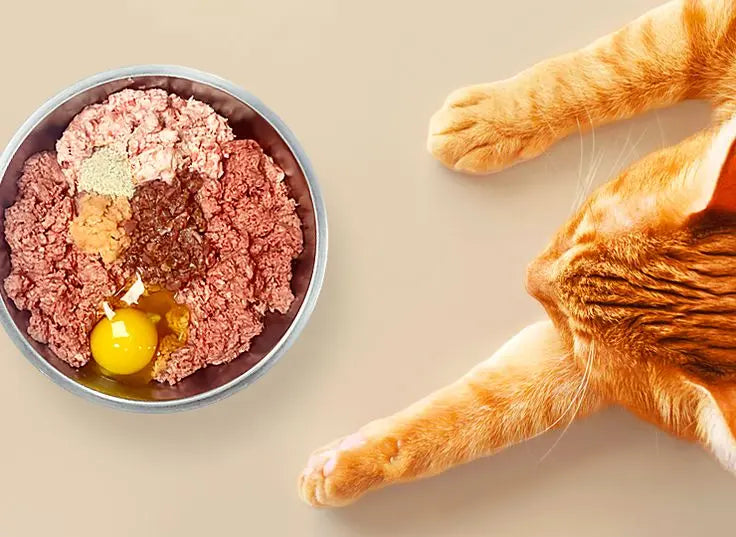
Feeding a Persian cat in India requires more than picking the bag with the breed name on it. India's 40°C summers, cold-chain gaps in tier-2 cities, and the wide price gap between kibble and fresh food all shift the answer. Add the Persian's flat skull, long coat, and genetic vulnerability to kidney and urinary disease - and the standard approach falls short fast. This guide covers everything.

Why Feeding a Persian Cat depends on their Biology as this Defines Their Feeding Needs

The Brachycephalic Skull and the Kibble Problem

The Persian's flat, compressed skull changes how the cat picks up food. Standard kibble shapes sit awkwardly in a brachycephalic jaw. Many Persians cannot bite down effectively, so they swallow pieces whole. Whole kibble means slower gastric emptying, more vomiting, and more hairball build-up. Ground or chopped raw, gently cooked, or wet food avoids the problem entirely. That is the mechanical issue. The nutritional issue runs deeper - and it starts with the coat.

The Long Coat's Nutritional Demands

The Persian coat is a single layer of fine, long fur. Building it requires animal-source fatty acids and amino acids every day. Without omega-3 (EPA and DHA), arachidonic acid, biotin, and zinc - most bioavailable from raw or gently cooked meat and oily fish - the coat thins, dander rises, and shedding doubles. Heat-extruded kibble fats are degraded during processing. A Persian on kibble alone rarely gets enough of these nutrients in bioavailable form. Dullness, matting, and excess dandruff are diet signals before they are grooming problems.

Persian Cat Breed

Genetic Predispositions: FLUTD, PKD and IBD

Persians are clinically over-represented for three conditions: feline lower urinary tract disease (FLUTD), polycystic kidney disease (PKD), and inflammatory bowel disease (IBD). The biggest dietary lever for all three is moisture. Dry kibble delivers 8–10% moisture. A raw or wet diet delivers 65–75%. In India's 38–42°C summers, that gap becomes medically critical.

VETERINARY NOTE
Persians are obligate carnivores. They require arachidonic acid, taurine, and pre-formed vitamin A from animal sources - not plant ingredients. This is feline metabolic biochemistry, not opinion.

Feeding a Persian Cat in India - Chart, Costs and Food Types

Now to the practical side of feeding a Persian cat in India: how much to feed, what it costs in rupees, which food types perform best, and which Indian kitchen staples are quietly toxic.

Daily Feeding Chart - Kitten to Senior

The right amount depends on body weight, life stage, activity level, and food density. Below is a vet- reviewed starting framework for fresh, raw, or gently cooked diets. Reduce by 10–15% for dense commercial cooked formats. Never underfeed kittens or nursing queens. Adjust ±10% over two weeks based on body condition and reweigh monthly.

Daily Feeding Chart

HOW TO USE THIS CHART
Find your Persian's life stage and weight band. Take the mid-range of grams per day and split across recommended meals. You should be able to feel your cat's ribs without pressing hard, and see a visible waist from above. Consult your vet before deviating more than 15% from these ranges.

Persian Cat Food Cost in India - ₹/Month Breakdown

Most Indian Persian owners have no idea what their cat's food actually costs per day. Royal Canin Persian Adult retails around ₹1,200–₹1,400 per 400g, and a typical Persian needs about 60g/day - that works out to ₹180–₹210/day on kibble alone. A vet-formulated fresh diet from BARF India costs ₹65–₹95/day at 60–75% moisture.

Persian Cat Food Cost in India

The math surprises most owners. Switching from Royal Canin Persian to BARF India fresh food saves roughly ₹2,000–₹4,500 per month. Over 12 months, that is ₹24,000–₹54,000 saved - before counting avoided vet bills for urinary blockages and IBD flare-ups.

Purple label for Cooked Cat Food - Grain Free Chicken & Tuna Recipe (1.75kg | 7x250g) by www.barfindia.com. Features cat graphic, feeding guidelines, ingredients, safety info, and maker details. All-natural, preservative-free, family-owned brand.
An orange label for Cooked Cat Food – Grain-Free Buffalo & Chicken Recipe (1.75kg | 7x250g) from www.barfindia.com lists ingredients, feeding instructions, and safety info. A gray-striped cartoon cat stretches at the bottom left. Made in India.
Blue label for Cooked Cat Food - Grain-free Mackerel & Pork Recipe (1.75 kg, 7x250g) by www.barfindia.com. High protein, with ingredients and feeding instructions. Gray striped cat illustration; yellow safety info box on right.
Cooked Cat Food - Grain free Rabbit & Quail Recipe (1.75kg, 7x250g) label features ingredients, feeding and storage instructions, allergy warnings, manufacturer info (www.barfindia.com), and a gray tabby cat illustration on a pink background.
Yellow label for Sampler Pack - Gently Cooked Cat Food by www.barfindia.com, highlighting all-natural, preservative-free boneless chicken. Includes a cartoon cat, feeding guide, ingredients, storage tips, manufacturer info, and 250g net weight.
An infographic for www.barfindia.com’s Sampler Pack - Gently Cooked Cat Food shows five steps—Protein, Prep Produce, Cold Combine, Pack & Freeze, Test/Ship/Enjoy—with brief descriptions and illustrated icons for each.
Purple label for Cooked Cat Food - Grain Free Chicken & Tuna Recipe (1.75kg | 7x250g) by www.barfindia.com. Features cat graphic, feeding guidelines, ingredients, safety info, and maker details. All-natural, preservative-free, family-owned brand.
An orange label for Cooked Cat Food – Grain-Free Buffalo & Chicken Recipe (1.75kg | 7x250g) from www.barfindia.com lists ingredients, feeding instructions, and safety info. A gray-striped cartoon cat stretches at the bottom left. Made in India.
Blue label for Cooked Cat Food - Grain-free Mackerel & Pork Recipe (1.75 kg, 7x250g) by www.barfindia.com. High protein, with ingredients and feeding instructions. Gray striped cat illustration; yellow safety info box on right.
Cooked Cat Food - Grain free Rabbit & Quail Recipe (1.75kg, 7x250g) label features ingredients, feeding and storage instructions, allergy warnings, manufacturer info (www.barfindia.com), and a gray tabby cat illustration on a pink background.
Yellow label for Sampler Pack - Gently Cooked Cat Food by www.barfindia.com, highlighting all-natural, preservative-free boneless chicken. Includes a cartoon cat, feeding guide, ingredients, storage tips, manufacturer info, and 250g net weight.
An infographic for www.barfindia.com’s Sampler Pack - Gently Cooked Cat Food shows five steps—Protein, Prep Produce, Cold Combine, Pack & Freeze, Test/Ship/Enjoy—with brief descriptions and illustrated icons for each.

Sampler Pack - Gently Cooked Cat Food

Rs. 320.00
An orange label for Cooked Cat Food – Grain-Free Buffalo & Chicken Recipe (1.75kg | 7x250g) from www.barfindia.com lists ingredients, feeding instructions, and safety info. A gray-striped cartoon cat stretches at the bottom left. Made in India.
An infographic shows 5 safe steps for prepping Cooked Cat Food – Grain-Free Buffalo & Chicken Recipe (1.75kg | 7x250g) by www.barfindia.com: steam/thaw protein, wash/steam produce, cold combine, pack/freeze, test/ship/enjoy!.
Infographic displays daily portions for adult cats (2.7–7.2 kg) in grams/day for Cooked Cat Food – Grain-Free Buffalo & Chicken Recipe (1.75kg | 7x250g) by www.barfindia.com, with a cartoon cat and tips to adjust food for activity and treats.
Infographic for Cooked Cat Food – Grain-Free Buffalo & Chicken Recipe (1.75kg) from www.barfindia.com: Holistic vet-crafted, high-protein, 87% chicken, liver, eggs, mussels & oysters with veggies and healthy fats. Small batch made.
An orange label for Cooked Cat Food – Grain-Free Buffalo & Chicken Recipe (1.75kg | 7x250g) from www.barfindia.com lists ingredients, feeding instructions, and safety info. A gray-striped cartoon cat stretches at the bottom left. Made in India.
An infographic shows 5 safe steps for prepping Cooked Cat Food – Grain-Free Buffalo & Chicken Recipe (1.75kg | 7x250g) by www.barfindia.com: steam/thaw protein, wash/steam produce, cold combine, pack/freeze, test/ship/enjoy!.
Infographic displays daily portions for adult cats (2.7–7.2 kg) in grams/day for Cooked Cat Food – Grain-Free Buffalo & Chicken Recipe (1.75kg | 7x250g) by www.barfindia.com, with a cartoon cat and tips to adjust food for activity and treats.
Infographic for Cooked Cat Food – Grain-Free Buffalo & Chicken Recipe (1.75kg) from www.barfindia.com: Holistic vet-crafted, high-protein, 87% chicken, liver, eggs, mussels & oysters with veggies and healthy fats. Small batch made.

Cooked Cat Food – Grain-Free Buffalo & Chicken Recipe (1.75kg | 7x250g)

Rs. 2,100.00
Purple label for Cooked Cat Food - Grain Free Chicken & Tuna Recipe (1.75kg | 7x250g) by www.barfindia.com. Features cat graphic, feeding guidelines, ingredients, safety info, and maker details. All-natural, preservative-free, family-owned brand.
Infographic for Cooked Cat Food - Grain Free Chicken & Tuna Recipe (1.75kg, 7x250g) by www.barfindia.com: Pie chart—87% meat & seafood, 9% fats/seeds/root veggies, 4% dark green veggies. Small batch, gently cooked, human-grade ingredients.
Purple label for Cooked Cat Food - Grain Free Chicken & Tuna Recipe (1.75kg | 7x250g) by www.barfindia.com. Features cat graphic, feeding guidelines, ingredients, safety info, and maker details. All-natural, preservative-free, family-owned brand.
Infographic for Cooked Cat Food - Grain Free Chicken & Tuna Recipe (1.75kg, 7x250g) by www.barfindia.com: Pie chart—87% meat & seafood, 9% fats/seeds/root veggies, 4% dark green veggies. Small batch, gently cooked, human-grade ingredients.

Cooked Cat Food - Grain Free Chicken & Tuna Recipe. 1.75kg | 7x250g

Rs. 1,995.00
A bright yellow
Infographic for Cooked Cat Food - Grain Free Chicken Recipe (1.75kg) by www.barfindia.com: 87% chicken, liver, eggs, mussels & oysters; 9% healthy fats, seeds & root veggies; 4% dark green veggies. Circular chart on yellow background.
Chart shows daily food portions (grams) for adult cats (2.7–7.2kg) for Cooked Cat Food - Grain Free Chicken Recipe by www.barfindia.com. Includes guidance, cartoon cat, and note to adjust for activity and treats. Pack: 1.75kg (7x250g).
Discover how www.barfindia.com's Cooked Cat Food - Grain Free Chicken Recipe (1.75kg, 7x250g) is made in five steps: select protein, prep produce, combine cold, pack & freeze, test & ship! Includes grain-free tips and vivid illustrations for each stage.
A plate with chicken breast, hearts, liver, mussels, shrimp, kidney, oysters, organic egg, and a creamy mix—each labeled as www.barfindia.com Cooked Cat Food - Grain Free Chicken Recipe ingredients.
A bright yellow
Infographic for Cooked Cat Food - Grain Free Chicken Recipe (1.75kg) by www.barfindia.com: 87% chicken, liver, eggs, mussels & oysters; 9% healthy fats, seeds & root veggies; 4% dark green veggies. Circular chart on yellow background.
Chart shows daily food portions (grams) for adult cats (2.7–7.2kg) for Cooked Cat Food - Grain Free Chicken Recipe by www.barfindia.com. Includes guidance, cartoon cat, and note to adjust for activity and treats. Pack: 1.75kg (7x250g).
Discover how www.barfindia.com's Cooked Cat Food - Grain Free Chicken Recipe (1.75kg, 7x250g) is made in five steps: select protein, prep produce, combine cold, pack & freeze, test & ship! Includes grain-free tips and vivid illustrations for each stage.
A plate with chicken breast, hearts, liver, mussels, shrimp, kidney, oysters, organic egg, and a creamy mix—each labeled as www.barfindia.com Cooked Cat Food - Grain Free Chicken Recipe ingredients.

Cooked Cat Food - Grain Free Chicken Recipe - 1.75kg (7x250g)

Rs. 1,780.00
Blue label for Cooked Cat Food - Grain-free Mackerel & Pork Recipe (1.75 kg, 7x250g) by www.barfindia.com. High protein, with ingredients and feeding instructions. Gray striped cat illustration; yellow safety info box on right.
A circular infographic features www.barfindia.com’s Cooked Cat Food - Grain-free Mackerel & Pork Recipe: 87% pork, mackerel & organs; 4% dark green veggies; 9% healthy fats, seeds & roots—ideal for raw feeding. Pack: 1.75 kg (7x250g).
Nutrition details for www.barfindia.com's Cooked Cat Food - Grain-free Mackerel & Pork Recipe (1.75 kg), including ingredients such as pork, mackerel, and spinach; macronutrient content, calorie sources, energy analysis, and omega-6/omega-3 ratio.
Infographic: How to prepare www.barfindia.com Cooked Cat Food - Grain-free Mackerel & Pork Recipe (1.75 kg)—steam/freeze protein, prep produce, mix with omega-3 oil, portion and freeze, then test before serving your cat.
Infographic shows daily portion ranges of Cooked Cat Food - Grain-free Mackerel & Pork Recipe by www.barfindia.com for adult cats from 2.7kg to 7.2kg, with cartoon cat and high-protein feeding advice. Pack: 1.75kg (7x250g).
Blue label for Cooked Cat Food - Grain-free Mackerel & Pork Recipe (1.75 kg, 7x250g) by www.barfindia.com. High protein, with ingredients and feeding instructions. Gray striped cat illustration; yellow safety info box on right.
A circular infographic features www.barfindia.com’s Cooked Cat Food - Grain-free Mackerel & Pork Recipe: 87% pork, mackerel & organs; 4% dark green veggies; 9% healthy fats, seeds & roots—ideal for raw feeding. Pack: 1.75 kg (7x250g).
Nutrition details for www.barfindia.com's Cooked Cat Food - Grain-free Mackerel & Pork Recipe (1.75 kg), including ingredients such as pork, mackerel, and spinach; macronutrient content, calorie sources, energy analysis, and omega-6/omega-3 ratio.
Infographic: How to prepare www.barfindia.com Cooked Cat Food - Grain-free Mackerel & Pork Recipe (1.75 kg)—steam/freeze protein, prep produce, mix with omega-3 oil, portion and freeze, then test before serving your cat.
Infographic shows daily portion ranges of Cooked Cat Food - Grain-free Mackerel & Pork Recipe by www.barfindia.com for adult cats from 2.7kg to 7.2kg, with cartoon cat and high-protein feeding advice. Pack: 1.75kg (7x250g).

Cooked Cat Food - Grain-free Mackerel & Pork Recipe - 1.75 kg (7x250g)

Rs. 1,950.00
Cooked Cat Food - Grain free Rabbit & Quail Recipe (1.75kg, 7x250g) label features ingredients, feeding and storage instructions, allergy warnings, manufacturer info (www.barfindia.com), and a gray tabby cat illustration on a pink background.
Discover our Cooked Cat Food - Grain free Rabbit & Quail Recipe (1.75kg) by www.barfindia.com: 87% rabbit, quail, liver, eggs, mussels & oysters; small batch cooked for complete cat nutrition.
An infographic titled “Recommended Daily Portions: Adult Cat” displays daily amounts of Cooked Cat Food - Grain Free Rabbit & Quail Recipe (1.75kg, 7x250g) for cats from 2.7kg to 7.2kg, with tips on activity and supplement adjustments from www.barfindia.com.
A colorful infographic from www.barfindia.com shows the 5-step process of making Cooked Cat Food - Grain free Rabbit & Quail Recipe (1.75kg): protein cooking, prepping produce, cold combining, packing/freezing, then testing and delivery.
Cooked Cat Food - Grain free Rabbit & Quail Recipe (1.75kg, 7x250g) label features ingredients, feeding and storage instructions, allergy warnings, manufacturer info (www.barfindia.com), and a gray tabby cat illustration on a pink background.
Discover our Cooked Cat Food - Grain free Rabbit & Quail Recipe (1.75kg) by www.barfindia.com: 87% rabbit, quail, liver, eggs, mussels & oysters; small batch cooked for complete cat nutrition.
An infographic titled “Recommended Daily Portions: Adult Cat” displays daily amounts of Cooked Cat Food - Grain Free Rabbit & Quail Recipe (1.75kg, 7x250g) for cats from 2.7kg to 7.2kg, with tips on activity and supplement adjustments from www.barfindia.com.
A colorful infographic from www.barfindia.com shows the 5-step process of making Cooked Cat Food - Grain free Rabbit & Quail Recipe (1.75kg): protein cooking, prepping produce, cold combining, packing/freezing, then testing and delivery.

Cooked Cat Food - Grain free Rabbit & Quail Recipe – 1.75kg (7x250g)

Rs. 2,350.00

Raw vs Cooked vs Wet vs Kibble - Which Is Best?

Every Indian Persian owner asks which food type is best. The honest answer sits on a spectrum: the closer to ancestral prey, the better the Persian responds clinically. Here is the decision tree for the four main formats available in India.

Raw (BARF / Prey-Model): Best for Persians of any age in good health - especially those with hairballs, dull coat, recurring UTI, or mild IBD. Requires cold-chain delivery and overnight fridge- thawing. BARF India ships frozen across most Indian metros.

Gently Cooked: Best for households uncomfortable with raw, or with young children or immuno- compromised members. Retains 60–70% moisture and most nutritional benefit. Small loss of heat- sensitive nutrients is supplemented in commercial formulas.

Wet Food (Pouches / Cans): Better than kibble for moisture (70–80%). Typically retort-sterilised at high heat. Many Indian wet pouches are 70–80% gravy and only 20–30% animal protein. Expensive at ₹250–₹400/day.

Premium Kibble (Royal Canin Persian, Hill's): Useful for travel or emergency back-up. Breed-shaped pieces help Persians grasp food. But 8–10% moisture and 30–40% carbs make it a poor long-term daily staple for Persian-specific conditions.

Persian Cat Breed

Foods to Never Give a Persian Cat - Indian Kitchen Edition

Indian households share food with pets far more than most Western ones. Sambhar leftovers, biryani scraps, and evening chai biscuits are common offerings. Several everyday Indian kitchen items range from mildly harmful to acutely toxic for Persians. The table below covers the most frequent mistakes.

Foods to Never Give a Persian Cat

Health and Transitions

Persian Coat Health - The Omega-3 and Hydration Link

Persian coats shed, mat, and develop dandruff - often because of what is in the food bowl, not a grooming problem. The single-layer coat is biochemically expensive. Each strand requires animal- source omega-3 (EPA and DHA) and arachidonic acid every day. Kibble fats are heat-degraded. Combine that with 8–10% moisture in a 38°C summer and you get chronic dehydration, dull fur, and rising dander.

The coat response to switching to fresh food is one of the most consistent things Indian Persian owners report. Softer fur appears within 2–3 weeks. Reduced shedding follows at 4–6 weeks. Dander and scabby spots typically resolve by week 6–10. Coat colour in cream, blue, and tortoiseshell Persians often deepens visibly.

Kidney and Urinary Health in India's Climate

Polycystic kidney disease and FLUTD are over-represented in Persians. Diet is the single biggest modifiable variable. A Persian on dry kibble relies entirely on the water bowl - and Persians are notoriously poor self-regulators of water intake. The result is chronic mild dehydration: concentrated urine, slower kidney filtration, and higher risk of struvite crystal formation.

India's 38–42°C summers compound this significantly. A Persian's long coat reduces air circulation, raising water-loss rates. By July, the average kibble-fed Indian Persian is dehydrated enough that urine specific gravity climbs into crystal-formation territory. Moisture-rich fresh food is the simplest, most effective preventive step. Add multiple water bowls and a feline fountain for extra support.

NATURE HAS ALREADY GIVEN THE RECIPE. WE HAVE ONLY IMPLEMENTED ITPersian Cat Breed

Hairballs, IBD and Vomiting - Causes Most Owners Miss

Indian Persian owners are often told that weekly vomiting is normal for the breed. It is not normal. It is largely diet-driven. Persians on fresh diets show higher gut motility and faster transit. Fur passes through in stool rather than accumulating into hairballs. The reason is simple: fresh food does not expand in the stomach the way dry kibble does.

Inflammatory bowel disease is disproportionately diagnosed in Persians. Breeder data from decade- long programmes shows dramatic reduction in chronic intestinal inflammation when fresh diets replace processed kibble. Heat-denatured proteins in extruded kibble can act as novel antigens to the feline immune system. If your Persian vomits more than once a week, investigate the diet first.

Feeding Persian Kittens in India - Weaning to 12 Months

The first 12 months are the most metabolically important of a Persian's life. Skeletal frame, dentition, immune programming, and lifelong gut microbiome all form in this window. Underfeeding, overfeeding, or feeding the wrong food has consequences that surface at age 4 as IBD, age 7 as a urinary blockage, or age 10 as kidney disease.

Weaning (4–8 weeks): Transition from queen's milk to finely ground raw or gently cooked muscle meat with high-moisture bone broth from week 4. This builds the gut microbiome for protein digestion. Avoid carb-loaded starter pellets.

Juvenile (8 weeks–12 months): Feed 4–5 small meals daily at 8–12 weeks, dropping to 3 meals by 6 months. Include 10% liver and 10% other organ meat. Rotate proteins weekly - chicken, turkey, quail, fish - to prevent sensitisation.

What to avoid: Cow milk past weaning, all-kibble starts, skipping organ meat, and free-feeding. Persian kittens self-regulate poorly - portion every meal.

Feeding a Persian Cat - The 4-Week Kibble-to-Fresh Transition Protocol

A Persian eating kibble for years has a gut microbiome adapted to starch and rendered fat. Cold-turkey switching causes loose stool as the microbiome recalibrates - uncomfortable but not dangerous. A 4- week gradual transition is the safest path. Never withhold food during any phase: Persians risk hepatic lipidosis after 24 hours without eating.

4-Week Kibble-to-Fresh Transition Protocol

Royal Canin Persian vs BARF India - Honest Comparison

Royal Canin Persian Adult earned its position in India through strong distribution, breed-specific marketing, and 30+ years of presence. It is the best mass-market kibble for Persians. But best kibble is a low ceiling - 8–10% moisture, 30–40% carbohydrates, and dehydrated poultry meal rather than whole-meat protein. The table below gives the honest side-by-side comparison.

Royal Canin Persian vs BARF India

LEARN MORE ABOUT INDIA'S NO.1 FRESH CAT FOOD

Start Fresh

Vet Concerns About Raw Diets - What the Evidence Shows

Two concerns come up most often: bacterial contamination and nutritional imbalance. Both are legitimate. Both are manageable. Properly sourced, commercially prepared raw diets from a vet- formulated brand carry very low pathogen risk. Cats have shorter, more acidic GI tracts than humans. Clinical data has not linked raw-fed pet households to higher disease incidence when basic food-safety hygiene is followed.

On completeness: a commercially prepared raw diet aligned with AAFCO or FEDIAF is, by definition, nutritionally complete. BARF India recipes are formulated by a veterinary nutritionist against feline NRC and AAFCO standards, with each batch micronutrient-tested. A randomly assembled homemade raw meal without vet guidance is a different, higher-risk category.

On taurine: raw and gently cooked meat - especially heart muscle, dark poultry, and fresh fish - supplies taurine in its natural bioavailable form. Heat-extruded kibble loses some taurine in processing, then re-supplements it synthetically. That works, but it is one step further from how cats evolved to obtain it.

Persian Cat Breed
An infographic for Dog Treats Natural Omega 3 - Dehydrated Anchovies (100g) by www.barfindia.com, highlighting omega-3 benefits, zero preservatives, Indian sourcing, storage tips, contact info, plus fish and plant illustrations.
A wooden spoon filled with Dog Treats Natural Omega 3 - Dehydrated Anchovies (100 gms) by www.barfindia.com rests on a pile of similar treats.
Dog Treats Natural Omega 3 - Dehydrated Anchovies (100 gms) from www.barfindia.com: small silvery fish with visible eyes, closely arranged—ideal as natural omega-3 dog snacks.
A close-up of Dog Treats Natural Omega 3 - Dehydrated Anchovies (100 gms) by www.barfindia.com shows whole anchovies with eyes and fins, tightly packed—ideal natural, flavorful snacks for your dog.
An infographic for Dog Treats Natural Omega 3 - Dehydrated Anchovies (100g) by www.barfindia.com, highlighting omega-3 benefits, zero preservatives, Indian sourcing, storage tips, contact info, plus fish and plant illustrations.
A wooden spoon filled with Dog Treats Natural Omega 3 - Dehydrated Anchovies (100 gms) by www.barfindia.com rests on a pile of similar treats.
Dog Treats Natural Omega 3 - Dehydrated Anchovies (100 gms) from www.barfindia.com: small silvery fish with visible eyes, closely arranged—ideal as natural omega-3 dog snacks.
A close-up of Dog Treats Natural Omega 3 - Dehydrated Anchovies (100 gms) by www.barfindia.com shows whole anchovies with eyes and fins, tightly packed—ideal natural, flavorful snacks for your dog.

Dog Treats Natural Omega 3 - Dehydrated Anchovies - 100 gms.

Rs. 260.00
Dog Treats - Dehydrated Pork Hearts (60 gms) from www.barfindia.com are single-ingredient, all-natural pork heart treats with no additives or preservatives, packed in a white and pink resealable bag—perfect for your pet.
A white resealable bag with a pink label for www.barfindia.com Dog Treats - Dehydrated Pork Hearts (60 gms), displaying feeding guidelines, product benefits, convenience, and usage instructions.
Two pieces of dehydrated pork hearts from www.barfindia.com, dark brown and irregularly shaped, are displayed on a white background—ideal as single-ingredient dog treats. Product: Dog Treats - Dehydrated Pork Hearts - 60 gms.
Dog Treats - Dehydrated Pork Hearts (60 gms) from www.barfindia.com are single-ingredient, all-natural pork heart treats with no additives or preservatives, packed in a white and pink resealable bag—perfect for your pet.
A white resealable bag with a pink label for www.barfindia.com Dog Treats - Dehydrated Pork Hearts (60 gms), displaying feeding guidelines, product benefits, convenience, and usage instructions.
Two pieces of dehydrated pork hearts from www.barfindia.com, dark brown and irregularly shaped, are displayed on a white background—ideal as single-ingredient dog treats. Product: Dog Treats - Dehydrated Pork Hearts - 60 gms.

Dog Treats - Dehydrated Pork Hearts - 60 gms

Rs. 300.00
A white resealable pouch with a red label shows
A white resealable pouch from www.barfindia.com, with a red label showing feeding guidelines, product info, and serving instructions. Contains 60g dehydrated chicken hearts for dogs & cats, rich in taurine, made in India—best kept refrigerated.
A black bowl of Dehydrated Chicken Hearts - 60gms from www.barfindia.com is garnished with parsley and sits on a dark textured surface, surrounded by scattered herbs and spices.
A pile of small, dark, slightly yellowish Dehydrated Chicken Hearts - 60gms is spread on a white surface.
A white resealable pouch with a red label shows
A white resealable pouch from www.barfindia.com, with a red label showing feeding guidelines, product info, and serving instructions. Contains 60g dehydrated chicken hearts for dogs & cats, rich in taurine, made in India—best kept refrigerated.
A black bowl of Dehydrated Chicken Hearts - 60gms from www.barfindia.com is garnished with parsley and sits on a dark textured surface, surrounded by scattered herbs and spices.
A pile of small, dark, slightly yellowish Dehydrated Chicken Hearts - 60gms is spread on a white surface.

Dehydrated Chicken Hearts - 60gms

Rs. 250.00
A resealable pouch labeled
Dog Treats Buffalo Heart - 60gms by www.barfindia.com comes in a white resealable pouch with a red label showing feeding guidelines, product details, and care instructions. These natural Indian pet treats are healthy and convenient.
A hand holds a piece of Dog Treats Buffalo Heart - 60 gms by www.barfindia.com, with more natural buffalo heart treats in the background—ideal for your furry friend.
A hand holds a piece of Dog Treats Buffalo Heart - 60 gms by www.barfindia.com over a pile of similar air-dried treats—wholesome, natural snacks perfect for rewarding your dog.
Three pieces of Dog Treats Buffalo Heart - 60 gms from www.barfindia.com are arranged on a white background. Their rough, uneven texture and curled edges make them ideal natural treats for your dog.
A resealable pouch labeled
Dog Treats Buffalo Heart - 60gms by www.barfindia.com comes in a white resealable pouch with a red label showing feeding guidelines, product details, and care instructions. These natural Indian pet treats are healthy and convenient.
A hand holds a piece of Dog Treats Buffalo Heart - 60 gms by www.barfindia.com, with more natural buffalo heart treats in the background—ideal for your furry friend.
A hand holds a piece of Dog Treats Buffalo Heart - 60 gms by www.barfindia.com over a pile of similar air-dried treats—wholesome, natural snacks perfect for rewarding your dog.
Three pieces of Dog Treats Buffalo Heart - 60 gms from www.barfindia.com are arranged on a white background. Their rough, uneven texture and curled edges make them ideal natural treats for your dog.

Dog Treats Buffalo Heart - 60 gms

Rs. 250.00
The www.barfindia.com Dog Treats - Dehydrated Sardines 100 gms pack label shows sardines and leafy designs, lists health benefits, safe handling tips, contact info, and quality certifications.
A round wicker basket holds many dehydrated sardines (Dog Treats - Dehydrated Sardines - 100 gms pack) atop a dark surface.
The www.barfindia.com Dog Treats - Dehydrated Sardines 100 gms pack label shows sardines and leafy designs, lists health benefits, safe handling tips, contact info, and quality certifications.
A round wicker basket holds many dehydrated sardines (Dog Treats - Dehydrated Sardines - 100 gms pack) atop a dark surface.

Dog Treats - Dehydrated Sardines - 100 gms pack

Rs. 270.00
A pile of Dog Treats - Dehydrated Squids (pieces) - 60gms from www.barfindia.com on a white background, with a small colorful www.barfindia.com logo in the top right corner.

Dog Treats - Dehydrated Squids (pieces) - 60gms

Rs. 649.00

FAQ's - Feeding a Persian Cat in India

How much should I feed my Persian cat per day?

An adult Persian (3.5–5.5 kg) needs roughly 180–260g of fresh food per day across two meals. Kittens 4–12 weeks need 80–120g in 4–5 meals. Juveniles need 130–220g in 3 meals. Seniors need 160–220g in 2 meals. Adjust ±10–15% based on body condition. Weigh your Persian monthly and recalibrate every 4–6 weeks.

What is the best food for a Persian cat in India?

The best food for a Persian cat in India is a vet-formulated fresh diet - raw or gently cooked - at 60–75% moisture, with whole-meat protein, organ meats, and omega-3 from oily fish. BARF India meets this profile at ₹65–₹95/day for an adult, less than half the cost of premium kibble.

Can Persian cats eat raw chicken?

Yes. Raw chicken is one of the most species-appropriate proteins for Persians. It supplies taurine, arachidonic acid, and natural moisture. Source from human-grade, hygienically handled, cold-chain suppliers. Rotate with turkey, fish, and quail to prevent sensitisation. BARF India's multi-protein range covers this rotation automatically.

What food is bad for Persian cats?

Avoid chocolate, onions, garlic, leeks, raisins, grapes, cooked bones, dog food, caffeine, sweets, and salty snacks. Cow milk causes diarrhoea in most adult Persians. Leftover Indian curries - containing onion, garlic, salt, and oil - are toxic. Avoid grain-heavy kibble and any food labelled "meat by-product" without a named protein source.

How many times a day should I feed my Persian?

Adult Persians should be fed twice a day - morning and evening. Kittens 4–12 weeks need 4–5 small meals; juveniles need 3 meals; seniors can stay at 2 or shift to 3 smaller meals if digestion slows. Avoid free-feeding kibble: Persians self-regulate poorly and gain weight quickly on grazing schedules.

Why does my Persian cat vomit after eating?

Most Persian vomiting on dry kibble happens because kibble expands in the stomach on hydration, irritating the gastric lining. The brachycephalic skull also causes many Persians to swallow pieces whole. Other causes include hairball build-up and food sensitivities to grains. Switching to a fresh, moisture-rich diet typically reduces vomiting within 4–6 weeks.

Is Royal Canin Persian good for my cat?

Royal Canin Persian is the best mass-market kibble for Persians - but that is a low ceiling. It is 8–10% moisture, 30–40% carbohydrates, and uses dehydrated poultry meal. It is a good travel back-up or 10–20% rotation component. For daily long-term feeding, a fresh diet is significantly better for Persian- specific health concerns.

How to switch a Persian cat from kibble to raw or fresh food?

Transition over 4 weeks: Days 1–7 at 75/25 old-to-fresh, Days 8–14 at 50/50, Days 15–21 at 25/75, Days 22–28 at 100% fresh. Watch stool consistency and slow down if it stays loose past day 5. Never withhold food - Persians risk hepatic lipidosis if they fast over 24 hours.

Ready to Feed Your Persian Right?

Feeding a Persian cat in India correctly is the single highest-leverage decision you will make as an owner. Get it right and you protect a 14–18 year lifespan against IBD, FLUTD, kidney disease, and obesity. Get it wrong and you fight those conditions one expensive vet visit at a time. BARF India's Persian Sampler Pack - vet-formulated, cold-chain delivered, AAFCO-aligned - is the lowest-risk way to start. ₹320. 7-day satisfaction guarantee. Free WhatsApp transition support included.
What To Read Next?

Persian Cat Breed

Persian Cat Breed

Mar 12, 2026
by
Nivedita Fernandes
Cat Food

Best Cat Food in India in 2026

Feb 26, 2026
by
Nivedita Fernandes