Raw for Maximum Nutrition

Made in our own Kitchens

Human grade products

Raw for Maximum Nutrition

Made in our own kitchens

Human grade products

20 April 2026

Feeding the Persian Cat Breed: Why Raw Food Is the Gold Standard

A veterinarian’s evidence-based perspective on optimal feline nutrition | Reviewed by a Feline Veterinary Nutritionist | Updated April 2026 | 10 min read

Persian Cat Breed

20 April 2026

Feeding the Persian Cat Breed: Why Raw Food Is the Gold Standard

A veterinarian’s evidence-based perspective on optimal feline nutrition | Reviewed by a Feline Veterinary Nutritionist | Updated April 2026 | 10 min read

Persian Cat Breed

Feeding the Persian Cat Breed is one of the most consequential decisions you will make as a guardian of this regal animal. As veterinarians, we have spent years observing the difference a species-appropriate diet makes - and the evidence points clearly toward raw, unprocessed food as the superior choice for Persian cats.

Why the Persian Cat Breed Has Unique Nutritional Needs

Persian Cats are stunning, gentle cats with luxurious coats, flat faces, and a calm disposition that makes them beloved companions worldwide. Yet their beauty is fragile. Their unique physiology - the brachycephalic skull, the fine single-layered fur, the sensitive gastrointestinal tract - demands a diet that supports rather than undermines their biology.

In this guide, we walk through exactly why raw food outperforms dry kibble and processed wet food for Persians, what the science says, and how to transition your cat safely and confidently.

OF CATS IMPROVE COAT QUALITY ON RAW WITHIN 60 DAYS
REDUCTION IN HAIRBALL FREQUENCY WITH RAW FEEDING
MOISTURE IN RAW VS. 8-10% IN DRY KIBBLE

Feeding the Persian Cat Breed Starts with Understanding Their Biology

Persians are obligate carnivores with a metabolic blueprint designed entirely around animal protein. Unlike humans or even dogs, cats lack the enzymatic machinery to manufacture certain essential amino acids and fatty acids. Therefore, every meal must supply them from animal sources - not grains, starches, or plant-derived fillers.

The flat-faced (brachycephalic) structure of a Persian also affects how it picks up and chews food. Many Persians struggle with standard kibble shapes because they cannot bite down effectively. Consequently, they may swallow kibble whole - a poor digestive start that raw, ground meat avoids entirely.

VETERINARY NOTE
Obligate carnivores like cats require arachidonic acid, taurine, and vitamin A in preformed animal- source form. Plants cannot meet these needs - no matter how'complete' the label claims.

Persian Cat Breed

Feeding the Persian Cat Breed: The Coat Factor

A Persian Cats coat is its most iconic feature. That dense, floor-length fur requires an abundance of omega-3 and omega-6 fatty acids - nutrients most abundant in raw meats, organ tissue, and fatty fish. Dry commercial diets often use rendered fats that have degraded through high-heat processing, delivering far less bioavailable lipid nutrition.

Furthermore, a dry-food diet typically provides only 8–10% moisture, far below the 65–75% moisture cats would naturally consume through prey. Chronic mild dehydration stresses the kidneys and skin - two systems that directly affect coat quality in the feeding the Persian cat breed context.

KEY NUTRIENTS FOR PERSIAN COAT HEALTH FROM RAW FOOD

• Omega-3 fatty acids (EPA & DHA) from raw fish and organ meat
• Arachidonic acid - found only in animal fat
• Biotin and B vitamins from raw liver and heart tissue
• Zinc and copper from muscle meat and green tripe
• High moisture content for kidney and skin hydration

Feeding the Persian Cat Breed: Why Kibble Falls Short

Commercial dry kibble was never designed with feline biology in mind. It was designed for convenience and shelf life. High-temperature extrusion destroys heat-sensitive enzymes and denatures proteins, reducing the bioavailability of the very nutrients a Persian needs most.

Moreover, most dry cat foods contain carbohydrate levels between 30–50% - nutrients that cats metabolize poorly. Excess carbohydrate drives blood glucose spikes, promotes weight gain, and disrupts the gut microbiome when feeding the Persian cat breed processed food.

“When I switched my Persian with IBD to a raw diet, her first week completely free of diarrhea - after years of suffering - was enough to sell me entirely. The change that raw feeding produced was nothing short of transformative.”

- Molly Barr, Mythicbells Persians (10+ years of raw feeding experience)

Persian Cat Breed

The Veterinary Case for Raw Food When Feeding the Persian Cat Breed

Feeding the Persian Cat Breed: Digestive Health and IBD Prevention

Inflammatory Bowel Disease (IBD) is disproportionately common in Persian cats. From a clinical standpoint, we see a direct correlation between processed dry food diets and the onset of chronic intestinal inflammation. In contrast, raw diets are species-appropriate, anti- inflammatory, and free of dietary triggers.

The gut microbiome of a cat fed raw protein looks markedly different from one fed processed kibble. Raw-fed cats show greater microbial diversity, more short-chain fatty acid production, and firmer, less odorous stools - a noticeably cleaner litter box and a healthier, more comfortable cat.

CLINICAL OBSERVATION
In raw-fed Persian colonies observed over multiple years, vets consistently report zero urinary blockages, dramatically reduced vomiting frequency, and near-elimination of skin lesions - conditions previously chalked up to breed tendencies.

Feeding the Persian Cat Breed: Urinary Tract Health

Persians are predisposed to feline lower urinary tract disease (FLUTD) and polycystic kidney disease (PKD). Chronic low-level dehydration - the inevitable consequence of a dry kibble diet - concentrates urine, promotes crystal formation, and accelerates kidney stress. Accordingly, any Persian with even minor urinary history should be moved to a high-moisture diet, ideally raw.

Raw food provides moisture levels of 60–75%, closely matching the water content of prey. This passive hydration dilutes urine, reduces crystal risk, and supports kidney filtration function over the long term when feeding the Persian cat breed correctly.

URINARY BENEFITS OF RAW FEEDING FOR PERSIANS

• Increased daily moisture intake without water bowl dependence
• Diluted urine reduces struvite and oxalate crystal risk
• Lower dietary phosphorus load from raw muscle meat
• Supports kidney filtration through hydration, not supplementation

Feeding the Persian Cat Breed: Weight Management and Metabolic Health

Persian cats are moderate-activity, indoor cats prone to weight gain when overfed carbohydrates. Raw diets are naturally low in carbohydrates and high in protein, which promotes lean muscle mass, suppresses insulin spikes, and provides lasting satiety. As a result, owners who switch to raw almost uniformly report more appropriate appetite and steadier body weight.

When feeding the Persian cat breed for long-term metabolic health, the macronutrient profile of raw food aligns perfectly with what obligate carnivores need: approximately 50–65% protein, 20–35% fat, and fewer than 5% carbohydrates.

Persian Cat Breed

Feeding the Persian Cat Breed: How Raw Diet Transforms Coat and Skin

In clinical practice, one of the most dramatic and rapid improvements seen after switching to raw is coat quality. Within 4–8 weeks, Persian owners consistently report softer fur, reduced shedding, less dandruff, and fewer greasy patches. This occurs because bioavailable fatty acids from raw meat directly feed the lipid layers of each hair shaft.

Skin lesions -  small, scabby patches along the back and neck - that many Persian owners accept as normal often disappear entirely on raw. From a dermatological standpoint, these are frequently allergic responses to heat-processed proteins or grain-derived antigens present in commercial kibble.

DERMATOLOGY INSIGHT
Processed pet food proteins are denatured at high temperatures, creating novel protein structures the cat’s immune system may recognize as foreign - triggering chronic low-grade skin inflammation. Raw proteins are structurally intact and far less likely to provoke this response.

A purple label for www.barfindia.com’s Sampler Pack - Gently Cooked Cat Food features a cartoon cat, ingredients list, feeding guide, brand info, and safety warning. It highlights an all-natural, preservative-free recipe made in India since 1986.
Orange label for www.barfindia.com Grain-Free Gently Cooked Buffalo & Chicken Cat Food (1.75kg, 7x250g), featuring feeding instructions, ingredients, safety tips, nutrition facts, holistic vet-crafted info, cartoon cat with string, and manufacturer details.
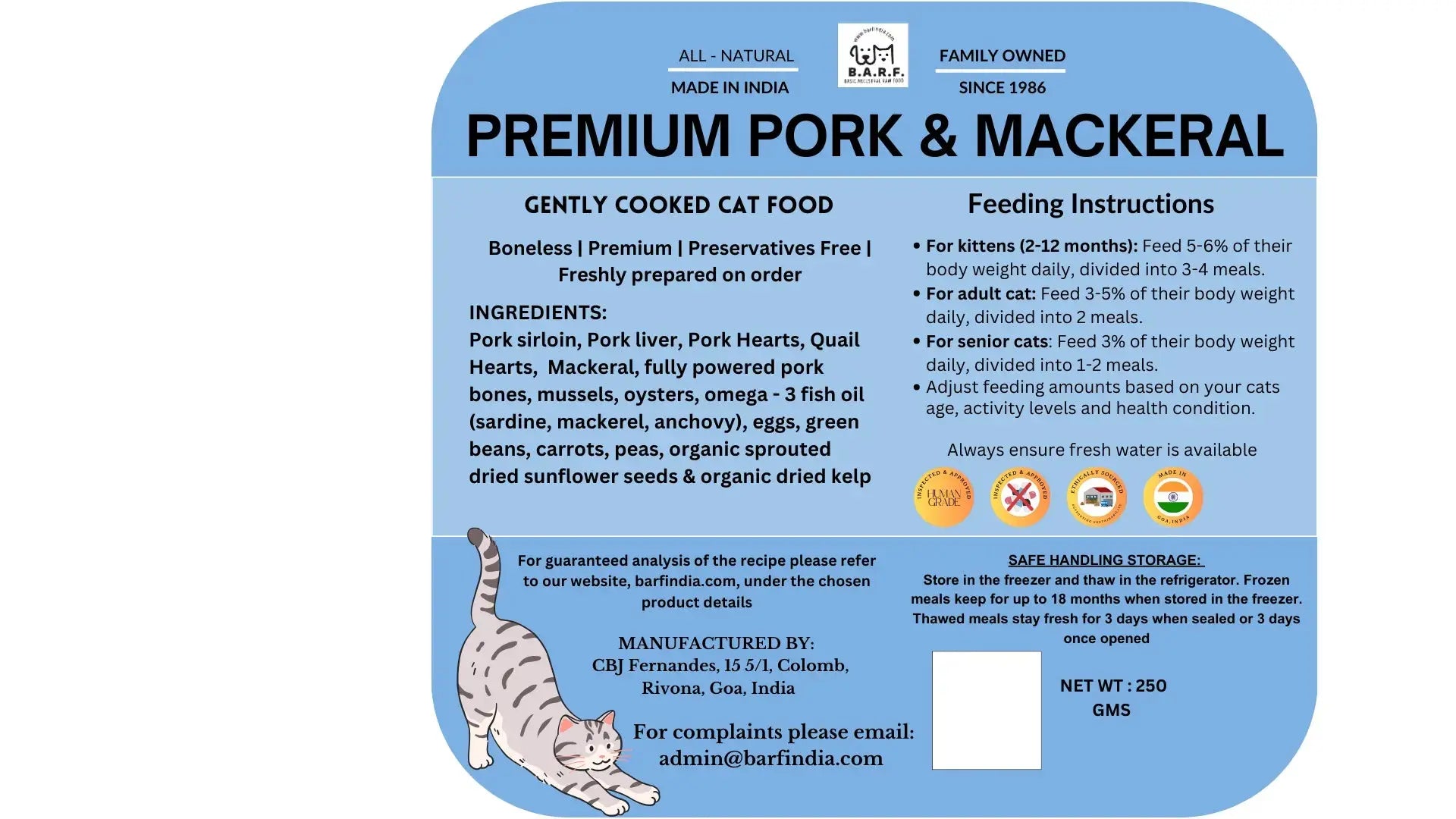
A blue label for preservative-free, all-natural Sampler Pack - Gently Cooked Cat Food by www.barfindia.com shows a playful striped cat, ingredients, feeding instructions, safety tips, manufacturer info, and a white barcode box. Family-owned.
A pink label for www.barfindia.com’s Sampler Pack - Gently Cooked Cat Food shows ingredients, feeding and safety info, and a gray-striped cartoon cat. Highlights include natural, boneless, preservative-free formula for cats.
Yellow label for Sampler Pack - Gently Cooked Cat Food by www.barfindia.com, highlighting all-natural, preservative-free boneless chicken. Includes a cartoon cat, feeding guide, ingredients, storage tips, manufacturer info, and 250g net weight.
An infographic for www.barfindia.com’s Sampler Pack - Gently Cooked Cat Food shows five steps—Protein, Prep Produce, Cold Combine, Pack & Freeze, Test/Ship/Enjoy—with brief descriptions and illustrated icons for each.
A purple label for www.barfindia.com’s Sampler Pack - Gently Cooked Cat Food features a cartoon cat, ingredients list, feeding guide, brand info, and safety warning. It highlights an all-natural, preservative-free recipe made in India since 1986.
Orange label for www.barfindia.com Grain-Free Gently Cooked Buffalo & Chicken Cat Food (1.75kg, 7x250g), featuring feeding instructions, ingredients, safety tips, nutrition facts, holistic vet-crafted info, cartoon cat with string, and manufacturer details.
A blue label for preservative-free, all-natural Sampler Pack - Gently Cooked Cat Food by www.barfindia.com shows a playful striped cat, ingredients, feeding instructions, safety tips, manufacturer info, and a white barcode box. Family-owned.
A pink label for www.barfindia.com’s Sampler Pack - Gently Cooked Cat Food shows ingredients, feeding and safety info, and a gray-striped cartoon cat. Highlights include natural, boneless, preservative-free formula for cats.
Yellow label for Sampler Pack - Gently Cooked Cat Food by www.barfindia.com, highlighting all-natural, preservative-free boneless chicken. Includes a cartoon cat, feeding guide, ingredients, storage tips, manufacturer info, and 250g net weight.
An infographic for www.barfindia.com’s Sampler Pack - Gently Cooked Cat Food shows five steps—Protein, Prep Produce, Cold Combine, Pack & Freeze, Test/Ship/Enjoy—with brief descriptions and illustrated icons for each.

Sampler Pack - Gently Cooked Cat Food

Rs. 320.00
Orange label for www.barfindia.com Grain-Free Gently Cooked Buffalo & Chicken Cat Food (1.75kg, 7x250g), featuring feeding instructions, ingredients, safety tips, nutrition facts, holistic vet-crafted info, cartoon cat with string, and manufacturer details.
Infographic with 5 illustrated steps to prepare Grain-Free Gently Cooked Buffalo & Chicken Cat Food (1.75kg, 7x250g) by www.barfindia.com: Protein, Prep Produce, Cold Combine, Pack & Freeze, Test-Ship-Enjoy; each step features an icon and description on a yellow-orange background.
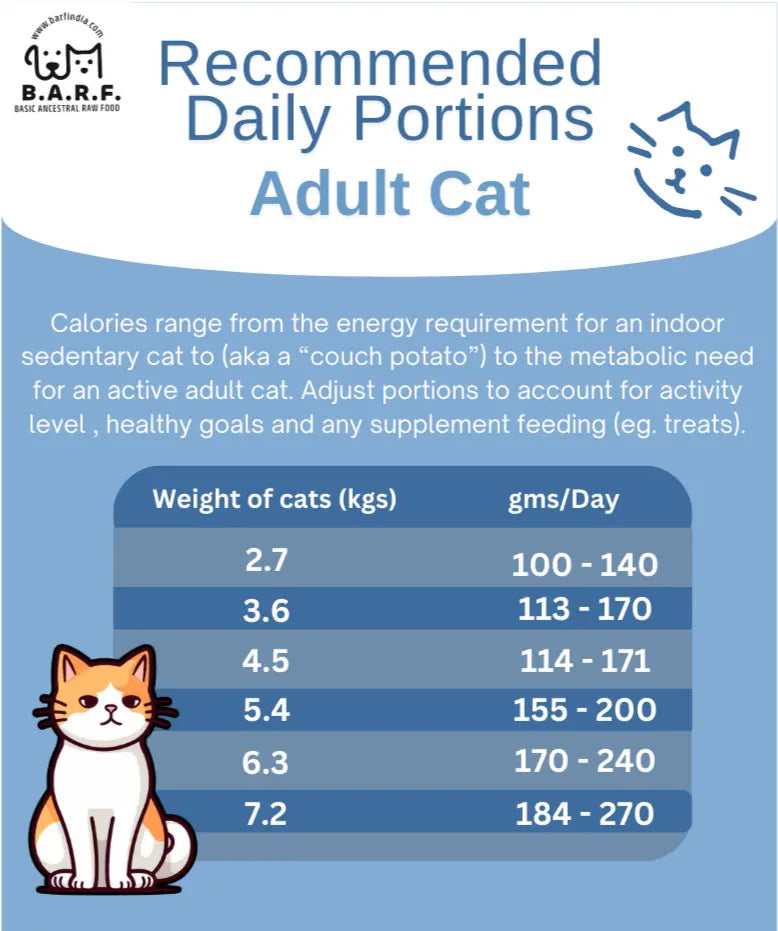
Infographic showing daily food portions for adult cats by weight, with recommended grams per day, made by holistic vets. Features www.barfindia.com Grain-Free Gently Cooked Buffalo & Chicken Cat Food (1.75kg). Adjust portions for activity and treats.
Infographic shows a holistic vet-crafted, high-protein cat food: 87% buffalo, chicken, liver, eggs, mussels & oysters; 4% dark green veggies; 9% fats, seeds & roots. Whole food by www.barfindia.com—Grain-Free Gently Cooked Buffalo & Chicken Cat Food (1.75kg).
Orange label for www.barfindia.com Grain-Free Gently Cooked Buffalo & Chicken Cat Food (1.75kg, 7x250g), featuring feeding instructions, ingredients, safety tips, nutrition facts, holistic vet-crafted info, cartoon cat with string, and manufacturer details.
Infographic with 5 illustrated steps to prepare Grain-Free Gently Cooked Buffalo & Chicken Cat Food (1.75kg, 7x250g) by www.barfindia.com: Protein, Prep Produce, Cold Combine, Pack & Freeze, Test-Ship-Enjoy; each step features an icon and description on a yellow-orange background.
Infographic showing daily food portions for adult cats by weight, with recommended grams per day, made by holistic vets. Features www.barfindia.com Grain-Free Gently Cooked Buffalo & Chicken Cat Food (1.75kg). Adjust portions for activity and treats.
Infographic shows a holistic vet-crafted, high-protein cat food: 87% buffalo, chicken, liver, eggs, mussels & oysters; 4% dark green veggies; 9% fats, seeds & roots. Whole food by www.barfindia.com—Grain-Free Gently Cooked Buffalo & Chicken Cat Food (1.75kg).

Grain-Free Gently Cooked Buffalo & Chicken Cat Food - 1.75kg (7x250g)

Rs. 2,100.00
A purple label for www.barfindia.com’s Sampler Pack - Gently Cooked Cat Food features a cartoon cat, ingredients list, feeding guide, brand info, and safety warning. It highlights an all-natural, preservative-free recipe made in India since 1986.
Infographic for www.barfindia.com’s Grain-Free Gently Cooked Cat Food – Chicken & Fish (1.75kg): Pie chart shows 87% meat/seafood, 4% dark green veggies, 9% healthy fats/seeds/root veggies. Features small batch, homemade recipes.
A purple label for www.barfindia.com’s Sampler Pack - Gently Cooked Cat Food features a cartoon cat, ingredients list, feeding guide, brand info, and safety warning. It highlights an all-natural, preservative-free recipe made in India since 1986.
Infographic for www.barfindia.com’s Grain-Free Gently Cooked Cat Food – Chicken & Fish (1.75kg): Pie chart shows 87% meat/seafood, 4% dark green veggies, 9% healthy fats/seeds/root veggies. Features small batch, homemade recipes.

Grain-Free Gently Cooked Cat Food - Chicken & Fish - 1.75kg (7x250g)

Rs. 1,995.00
A yellow label for Grain-Free Gently Cooked Chicken Cat Food – 1.75kg (7x250g) by www.barfindia.com, featuring ingredients, feeding guide, cat graphic, manufacturer info, storage tips, and benefits of all-natural, preservative-free gently cooked food.
Infographic for www.barfindia.com’s Grain-Free Gently Cooked Chicken Cat Food (1.75kg): 87% chicken, liver, eggs, mussels & oysters; 4% dark green veggies; 9% fats, seeds & roots. Small-batch cat food—perfect for kittens.
Infographic for www.barfindia.com's Grain-Free Gently Cooked Chicken Cat Food (1.75kg) shows daily portions by cat weight (100–270g), with tips to adjust for activity and treats. Features cat illustrations—perfect for gently cooked diets.
An infographic for www.barfindia.com’s Grain-Free Gently Cooked Chicken Cat Food (1.75kg, 7x250g) shows 5 steps—cook protein, prep produce, combine & chill, portion & freeze, ship—with icons and a delivery truck illustration.
A plate shows labeled ingredients for www.barfindia.com’s Grain-Free Gently Cooked Chicken Cat Food (1.75kg): chicken breast, hearts, liver, mussels, shrimp, kidney, oysters, and organic egg—perfect for grain-free chicken cat food recipes.
A yellow label for Grain-Free Gently Cooked Chicken Cat Food – 1.75kg (7x250g) by www.barfindia.com, featuring ingredients, feeding guide, cat graphic, manufacturer info, storage tips, and benefits of all-natural, preservative-free gently cooked food.
Infographic for www.barfindia.com’s Grain-Free Gently Cooked Chicken Cat Food (1.75kg): 87% chicken, liver, eggs, mussels & oysters; 4% dark green veggies; 9% fats, seeds & roots. Small-batch cat food—perfect for kittens.
Infographic for www.barfindia.com's Grain-Free Gently Cooked Chicken Cat Food (1.75kg) shows daily portions by cat weight (100–270g), with tips to adjust for activity and treats. Features cat illustrations—perfect for gently cooked diets.
An infographic for www.barfindia.com’s Grain-Free Gently Cooked Chicken Cat Food (1.75kg, 7x250g) shows 5 steps—cook protein, prep produce, combine & chill, portion & freeze, ship—with icons and a delivery truck illustration.
A plate shows labeled ingredients for www.barfindia.com’s Grain-Free Gently Cooked Chicken Cat Food (1.75kg): chicken breast, hearts, liver, mussels, shrimp, kidney, oysters, and organic egg—perfect for grain-free chicken cat food recipes.

Grain-Free Gently Cooked Chicken Cat Food – 1.75kg (7x250g)

Rs. 1,780.00
A blue label for preservative-free, all-natural Sampler Pack - Gently Cooked Cat Food by www.barfindia.com shows a playful striped cat, ingredients, feeding instructions, safety tips, manufacturer info, and a white barcode box. Family-owned.
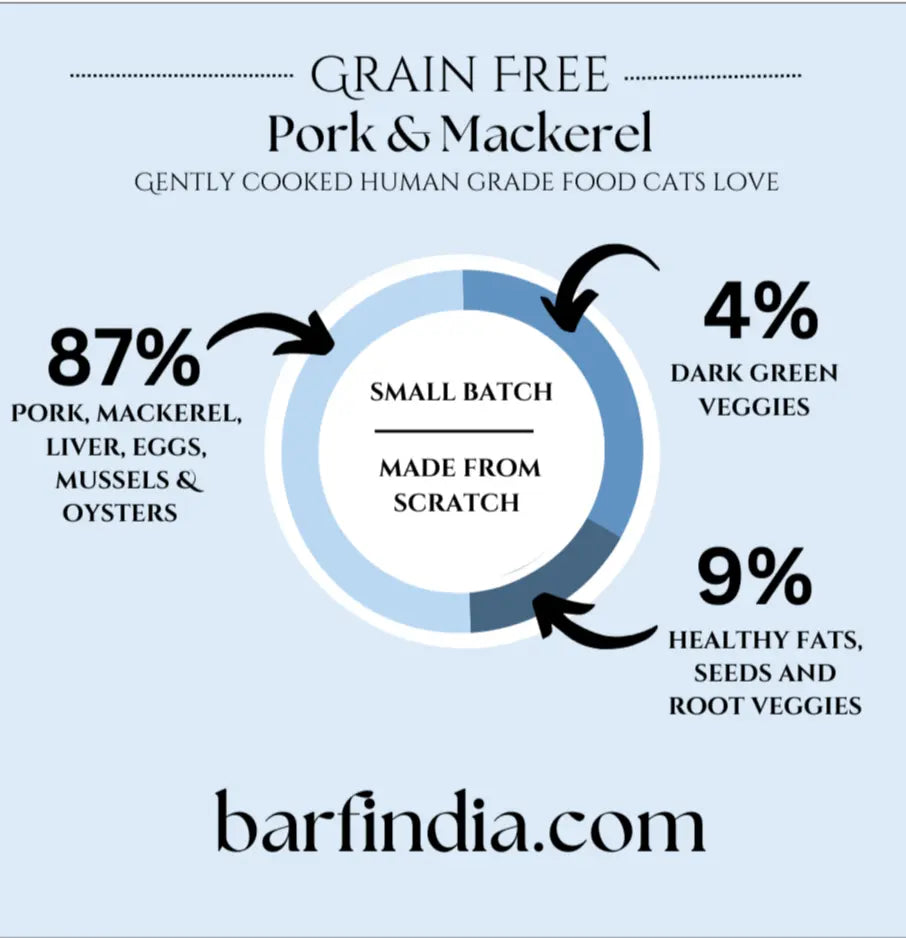
Infographic for Grain-Free Gently Cooked Mackerel & Pork Cat Food (1.75kg): 87% pork, mackerel, liver, eggs, mussels & oysters; 4% dark green veggies; 9% healthy fats/seeds. Complete nutrition. www.barfindia.com.
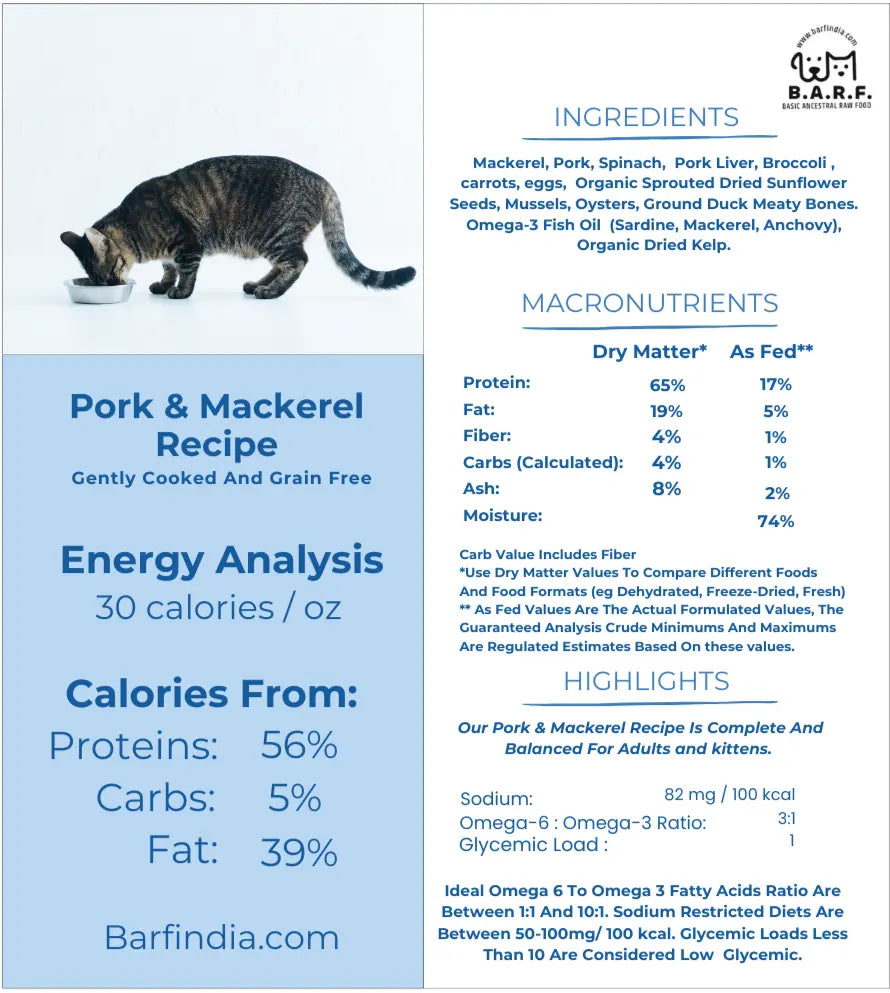
An informational poster for www.barfindia.com's Grain-Free Gently Cooked Mackerel & Pork Cat Food (1.75 kg), showing ingredients, macronutrients, energy analysis, calories, high protein, grain-free formula, and balanced omega ratios.
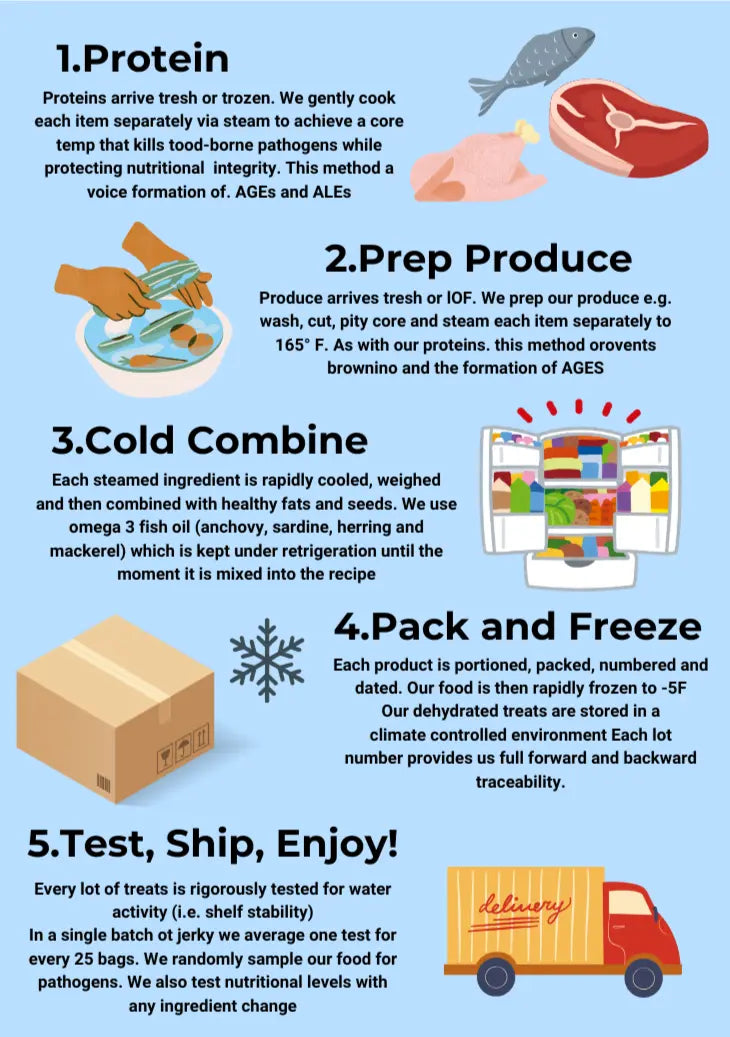
Infographic for www.barfindia.com’s Grain-Free Gently Cooked Mackerel & Pork Cat Food (1.75kg): five steps—protein cooking, produce prep, combining with healthy fats, packing/freezing, testing—each shown with icons and brief text.
Infographic from www.barfindia.com shows daily portions of Grain-Free Gently Cooked Mackerel & Pork Cat Food for adult cats: 2.7 kg cats need 100–140g, 7.2 kg cats need 184–270g. Includes cartoon cat and tips on adjusting food for activity/health.
A blue label for preservative-free, all-natural Sampler Pack - Gently Cooked Cat Food by www.barfindia.com shows a playful striped cat, ingredients, feeding instructions, safety tips, manufacturer info, and a white barcode box. Family-owned.
Infographic for Grain-Free Gently Cooked Mackerel & Pork Cat Food (1.75kg): 87% pork, mackerel, liver, eggs, mussels & oysters; 4% dark green veggies; 9% healthy fats/seeds. Complete nutrition. www.barfindia.com.
An informational poster for www.barfindia.com's Grain-Free Gently Cooked Mackerel & Pork Cat Food (1.75 kg), showing ingredients, macronutrients, energy analysis, calories, high protein, grain-free formula, and balanced omega ratios.
Infographic for www.barfindia.com’s Grain-Free Gently Cooked Mackerel & Pork Cat Food (1.75kg): five steps—protein cooking, produce prep, combining with healthy fats, packing/freezing, testing—each shown with icons and brief text.
Infographic from www.barfindia.com shows daily portions of Grain-Free Gently Cooked Mackerel & Pork Cat Food for adult cats: 2.7 kg cats need 100–140g, 7.2 kg cats need 184–270g. Includes cartoon cat and tips on adjusting food for activity/health.

Grain-Free Gently Cooked Mackeral & Pork Cat Food - 1.75 kg (7x250g)

Rs. 1,950.00
A pink label for www.barfindia.com’s Sampler Pack - Gently Cooked Cat Food shows ingredients, feeding and safety info, and a gray-striped cartoon cat. Highlights include natural, boneless, preservative-free formula for cats.
Infographic for www.barfindia.com Grain-Free Gently Cooked Rabbit & Quail Cat Food: 87% rabbit, quail, liver, eggs, mussels & oysters; 9% healthy fats, seeds & veggies; 4% dark greens. Small-batch crafted for balanced feline nutrition.
Infographic for www.barfindia.com Grain-Free Gently Cooked Rabbit & Quail Cat Food—recommended daily portions for adult cats by weight: 100–270g/day. Includes illustrated cat and tips to adjust feed based on activity and treats. Pack: 1.75kg (7x250g).
Infographic shows five steps for making www.barfindia.com Grain-Free Gently Cooked Rabbit & Quail Cat Food (1.75kg)—cooking protein, prepping produce, mixing cold items, packing/freezing, testing/shipping—each step features clear icons.
A pink label for www.barfindia.com’s Sampler Pack - Gently Cooked Cat Food shows ingredients, feeding and safety info, and a gray-striped cartoon cat. Highlights include natural, boneless, preservative-free formula for cats.
Infographic for www.barfindia.com Grain-Free Gently Cooked Rabbit & Quail Cat Food: 87% rabbit, quail, liver, eggs, mussels & oysters; 9% healthy fats, seeds & veggies; 4% dark greens. Small-batch crafted for balanced feline nutrition.
Infographic for www.barfindia.com Grain-Free Gently Cooked Rabbit & Quail Cat Food—recommended daily portions for adult cats by weight: 100–270g/day. Includes illustrated cat and tips to adjust feed based on activity and treats. Pack: 1.75kg (7x250g).
Infographic shows five steps for making www.barfindia.com Grain-Free Gently Cooked Rabbit & Quail Cat Food (1.75kg)—cooking protein, prepping produce, mixing cold items, packing/freezing, testing/shipping—each step features clear icons.

Grain-Free Gently Cooked Rabbit & Quail Cat Food – 1.75kg (7x250g)

Rs. 2,350.00

Feeding the Persian Cat Breed from Kittenhood: Starting Right

The best time to establish a raw diet for feeding the Persian cat breed is at weaning. Kittens raised on raw food from 4–5 weeks old show superior early immune development, stronger jaw muscles, denser bone structure, and faster growth compared to kibble-reared litters.

Notably, experienced Persian breeders who have transitioned their queens and kittens to raw report easier weaning, more consistent milk production in nursing queens, and no need for vitamin supplementation. The raw diet is appropriate for Persians at every life stage.

LIFE-STAGE RAW FEEDING RECOMMENDATIONS FOR PERSIANS

Kittens (4–12 weeks):
finely ground raw muscle meat with high-moisture bone broth
Juveniles (3–12 months):
ground raw with organ meat (10% liver, 10% secreting organ)
Adults (1–8 years):
balanced raw with fatty fish 2–3 times per week
 • Seniors (8+ years):
high-protein raw with added joint-supporting collagen sources
Nursing queens:
unrestricted raw access - they self-regulate intake based on need

Persian Cat Breed

Feeding the Persian Cat Breed: Hairballs, Vomiting, and the Raw Difference

Hairballs are often dismissed as an inevitable feature of owning a long-haired cat. However, when feeding the Persian cat breed a raw diet, hairball frequency drops dramatically. Raw-fed Persians have more efficient gut motility, moving ingested fur through the system rather than accumulating it for regurgitation.

Vomiting - another issue frequently blamed on the breed - is typically a dietary symptom rather than a breed characteristic. Cats on dry kibble vomit more because kibble expands in the stomach upon hydration, irritates the gastric lining, and provides poor lubrication for fur transit.

Feeding the Persian Cat Breed: Transitioning from Kibble to Raw Safely

Transitioning requires patience. A cat accustomed to processed food has a gut microbiome adapted to starch and rendered fat, not fresh protein. A rapid switch can cause temporary loose stools as the microbiome recalibrates. For this reason, a gradual 2–4 week transition is recommended.

Begin by replacing 25% of the current diet with raw, increasing by 25% every 4–5 days. Monitor stool consistency throughout. Most Persians fully adapt within 3–4 weeks when feeding the Persian cat breed the diet it was built for.

TRANSITION PROTOCOL
Week 1: 75% current food + 25% raw. Week 2: 50/50. Week 3: 25% current + 75% raw. Week 4: 100% raw. Adjust pace if stools become soft. Never withhold food to force acceptance.

Feeding the Persian Cat Breed: Commercially Prepared Raw vs. Home - Prepared

Not every Persian owner has the time or confidence to prepare home-made raw meals. Fortunately, the commercial raw pet food market has matured significantly. High-quality freeze- dried, frozen raw, and raw-coated products now deliver the benefits of raw with everyday convenience.

When selecting a commercial raw product for feeding the Persian cat breed, look for: named animal protein as the first ingredient, no artificial preservatives, grain-free formulation, inclusion of organ meat, and AAFCO or FEDIAF nutritional adequacy statements.

WHAT TO LOOK FOR ON THE RAW FOOD LABEL

• Named protein source (e.g. “chicken” not “poultry by-product”)
• Organ meat listed (liver, kidney, heart)
• Grain-free and starch-free formulation
• No artificial colours, flavours, or chemical preservatives
• AAFCO-complete or FEDIAF-complete nutritional statement

Persian Cat Breed

Feeding the Persian Cat Breed: Addressing Common Vet Concerns About Raw

Some veterinarians remain cautious about raw diets - primarily due to concerns about bacterial contamination and nutritional imbalance in home-prepared recipes. These concerns are legitimate but manageable. With that said, properly sourced, commercially prepared raw diets carry very low pathogen risk when handled with standard food-safety hygiene.

However, a nutritionally complete commercial raw diet or a home-prepared recipe formulated with veterinary guidance eliminates nutritional imbalance risk entirely. The benefits when feeding the Persian cat breed a properly balanced raw diet far outweigh the risks of a lifetime on dry food.

“When I presented my raw-fed cats at the veterinary clinic and was asked what I fed them, the vet’s response was simply: ‘Oh, that’s a good diet.’ Things had changed enormously in just a decade.”
— Molly Barr, Mythicbells Persians breeder

LEARN MORE ABOUT INDIA'S NO.1 FRESH CAT FOOD

Start Fresh

Feeding the Persian Cat Breed: Longevity and Quality of Life

Persians can live 15–20 years with proper care. The dietary choices made in the first few years of life set the metabolic foundation for that entire lifespan. Feeding the Persian cat breed a raw, species-appropriate diet from early life is one of the highest-leverage interventions available to any owner or breeder.

In practice, raw-fed Persian colonies maintained over 10+ years show remarkably low rates of the diseases that most commonly end Persian lives early: chronic kidney disease, IBD, obesity- related hepatic lipidosis, and FLUTD.

LONG-TERM HEALTH OUTCOMES IN RAW-FED PERSIAN POPULATIONS

• Significantly lower incidence of urinary tract disease and crystal formation
• Reduced prevalence of IBD and chronic vomiting syndromes
• Better maintained lean muscle mass into senior years
• Improved dental health from mechanical action of raw meat
• Higher reported owner satisfaction and cat quality of life scores

Persian Cat Breed

Feeding the Persian Cat Breed: Practical Tips for Daily Raw Feeding

Once fully transitioned, adult Persians typically eat twice daily - morning and evening. Frozen raw should be thawed overnight in the refrigerator and served at room temperature. Portion sizes should be adjusted to maintain ideal body condition when feeding the Persian cat breed daily.

Additionally, rotating protein sources is clinically advisable. Feeding exclusively one protein for years can create sensitization. Rotating between chicken, turkey, rabbit, duck, and occasional oily fish ensures broad nutritional coverage and reduces allergy risk over time.

DAILY FEEDING CHECKLIST
Thaw raw overnight in fridge · Serve at room temperature · Offer fresh water always · Rotate proteins weekly · Weigh portions to body condition · Refrigerate unused portions within 1 hour · Wash bowls between meals.

NATURE HAS ALREADY GIVEN THE RECIPE. WE HAVE ONLY IMPLEMENTED IT
An infographic for Dog Treats Natural Omega 3 - Dehydrated Anchovies (100g) by www.barfindia.com, highlighting omega-3 benefits, zero preservatives, Indian sourcing, storage tips, contact info, plus fish and plant illustrations.
A wooden spoon filled with Dog Treats Natural Omega 3 - Dehydrated Anchovies (100 gms) by www.barfindia.com rests on a pile of similar treats.
Dog Treats Natural Omega 3 - Dehydrated Anchovies (100 gms) from www.barfindia.com: small silvery fish with visible eyes, closely arranged—ideal as natural omega-3 dog snacks.
A close-up of Dog Treats Natural Omega 3 - Dehydrated Anchovies (100 gms) by www.barfindia.com shows whole anchovies with eyes and fins, tightly packed—ideal natural, flavorful snacks for your dog.
An infographic for Dog Treats Natural Omega 3 - Dehydrated Anchovies (100g) by www.barfindia.com, highlighting omega-3 benefits, zero preservatives, Indian sourcing, storage tips, contact info, plus fish and plant illustrations.
A wooden spoon filled with Dog Treats Natural Omega 3 - Dehydrated Anchovies (100 gms) by www.barfindia.com rests on a pile of similar treats.
Dog Treats Natural Omega 3 - Dehydrated Anchovies (100 gms) from www.barfindia.com: small silvery fish with visible eyes, closely arranged—ideal as natural omega-3 dog snacks.
A close-up of Dog Treats Natural Omega 3 - Dehydrated Anchovies (100 gms) by www.barfindia.com shows whole anchovies with eyes and fins, tightly packed—ideal natural, flavorful snacks for your dog.

Dog Treats Natural Omega 3 - Dehydrated Anchovies - 100 gms.

Rs. 260.00
Dog Treats - Dehydrated Pork Hearts (60 gms) from www.barfindia.com are single-ingredient, all-natural pork heart treats with no additives or preservatives, packed in a white and pink resealable bag—perfect for your pet.
A white resealable bag with a pink label for www.barfindia.com Dog Treats - Dehydrated Pork Hearts (60 gms), displaying feeding guidelines, product benefits, convenience, and usage instructions.
Two pieces of dehydrated pork hearts from www.barfindia.com, dark brown and irregularly shaped, are displayed on a white background—ideal as single-ingredient dog treats. Product: Dog Treats - Dehydrated Pork Hearts - 60 gms.
Dog Treats - Dehydrated Pork Hearts (60 gms) from www.barfindia.com are single-ingredient, all-natural pork heart treats with no additives or preservatives, packed in a white and pink resealable bag—perfect for your pet.
A white resealable bag with a pink label for www.barfindia.com Dog Treats - Dehydrated Pork Hearts (60 gms), displaying feeding guidelines, product benefits, convenience, and usage instructions.
Two pieces of dehydrated pork hearts from www.barfindia.com, dark brown and irregularly shaped, are displayed on a white background—ideal as single-ingredient dog treats. Product: Dog Treats - Dehydrated Pork Hearts - 60 gms.

Dog Treats - Dehydrated Pork Hearts - 60 gms

Rs. 300.00
A white resealable pouch with a red label shows
A white resealable pouch from www.barfindia.com, with a red label showing feeding guidelines, product info, and serving instructions. Contains 60g dehydrated chicken hearts for dogs & cats, rich in taurine, made in India—best kept refrigerated.
A black bowl of Dehydrated Chicken Hearts - 60gms from www.barfindia.com is garnished with parsley and sits on a dark textured surface, surrounded by scattered herbs and spices.
A pile of small, dark, slightly yellowish Dehydrated Chicken Hearts - 60gms is spread on a white surface.
A white resealable pouch with a red label shows
A white resealable pouch from www.barfindia.com, with a red label showing feeding guidelines, product info, and serving instructions. Contains 60g dehydrated chicken hearts for dogs & cats, rich in taurine, made in India—best kept refrigerated.
A black bowl of Dehydrated Chicken Hearts - 60gms from www.barfindia.com is garnished with parsley and sits on a dark textured surface, surrounded by scattered herbs and spices.
A pile of small, dark, slightly yellowish Dehydrated Chicken Hearts - 60gms is spread on a white surface.

Dehydrated Chicken Hearts - 60gms

Rs. 250.00
A resealable pouch labeled
Dog Treats Buffalo Heart - 60gms by www.barfindia.com comes in a white resealable pouch with a red label showing feeding guidelines, product details, and care instructions. These natural Indian pet treats are healthy and convenient.
A hand holds a piece of Dog Treats Buffalo Heart - 60 gms by www.barfindia.com, with more natural buffalo heart treats in the background—ideal for your furry friend.
A hand holds a piece of Dog Treats Buffalo Heart - 60 gms by www.barfindia.com over a pile of similar air-dried treats—wholesome, natural snacks perfect for rewarding your dog.
Three pieces of Dog Treats Buffalo Heart - 60 gms from www.barfindia.com are arranged on a white background. Their rough, uneven texture and curled edges make them ideal natural treats for your dog.
A resealable pouch labeled
Dog Treats Buffalo Heart - 60gms by www.barfindia.com comes in a white resealable pouch with a red label showing feeding guidelines, product details, and care instructions. These natural Indian pet treats are healthy and convenient.
A hand holds a piece of Dog Treats Buffalo Heart - 60 gms by www.barfindia.com, with more natural buffalo heart treats in the background—ideal for your furry friend.
A hand holds a piece of Dog Treats Buffalo Heart - 60 gms by www.barfindia.com over a pile of similar air-dried treats—wholesome, natural snacks perfect for rewarding your dog.
Three pieces of Dog Treats Buffalo Heart - 60 gms from www.barfindia.com are arranged on a white background. Their rough, uneven texture and curled edges make them ideal natural treats for your dog.

Dog Treats Buffalo Heart - 60 gms

Rs. 250.00
The www.barfindia.com Dog Treats - Dehydrated Sardines 100 gms pack label shows sardines and leafy designs, lists health benefits, safe handling tips, contact info, and quality certifications.
A round wicker basket holds many dehydrated sardines (Dog Treats - Dehydrated Sardines - 100 gms pack) atop a dark surface.
The www.barfindia.com Dog Treats - Dehydrated Sardines 100 gms pack label shows sardines and leafy designs, lists health benefits, safe handling tips, contact info, and quality certifications.
A round wicker basket holds many dehydrated sardines (Dog Treats - Dehydrated Sardines - 100 gms pack) atop a dark surface.

Dog Treats - Dehydrated Sardines - 100 gms pack

Rs. 270.00
A pile of Dog Treats - Dehydrated Squids (pieces) - 60gms from www.barfindia.com on a white background, with a small colorful www.barfindia.com logo in the top right corner.

Dog Treats - Dehydrated Squids (pieces) - 60gms

Rs. 649.00

FAQ'S : Persian Cat Breed Feeding

Is raw food truly safe for feeding the Persian cat breed?

Yes, when sourced from reputable suppliers and handled with standard food-safety practices, commercially prepared raw food carries very low pathogen risk. The key is purchasing from AAFCO-compliant manufacturers, thawing safely in the refrigerator, and washing bowls and prep surfaces after each meal. The health risks of a lifetime on carbohydrate-heavy dry kibble are far greater than the manageable handling risks of raw food.

How do I transition my Persian from kibble to raw without upsetting their stomach?

Use a gradual 2–4 week transition: replace 25% of the current diet with raw in week one, move to 50/50 in week two, 75% raw in week three, and 100% raw by week four. Monitor stool consistency throughout. Temporary soft stools are normal during gut microbiome adjustment. Never withhold food to force acceptance — try warming the raw food slightly to enhance aroma if your Persian is hesitant.

How does feeding the Persian cat breed raw food help with hairballs?

Raw food supports efficient gut motility, meaning ingested fur moves through the gastrointestinal tract rather than accumulating for regurgitation. The high moisture content lubricates the digestive tract, and the lack of starchy binders means there is no sticky medium for fur to clump around. Most raw-fed Persian owners report a dramatic reduction in hairball frequency within 4–6 weeks of switching.

Can Persian kittens be fed raw food from weaning age?

Absolutely — and it is the ideal time to start. Kittens weaned onto finely ground raw meat with adequate moisture develop stronger immune systems, superior jaw musculature, and a well- diversified gut microbiome from the start. Experienced Persian breeders who wean onto raw consistently report easier transitions, no need for vitamin supplementation, and healthier litter outcomes.

What proteins are best for feeding the Persian cat breed on a raw diet?

Rotate between chicken, turkey, rabbit, and duck as base proteins, and include oily fish such as sardines or mackerel two to three times weekly. Organ meat - particularly liver (no more than 10% of the diet) and secreting organs like kidney and spleen - is critical for vitamins A, D, and B12. Variety across protein sources prevents sensitization and ensures complete micronutrient coverage.

Will raw food help my Persian’s coat quality improve?

In clinical observation, coat quality is one of the fastest and most dramatic improvements seen after switching to raw. Within 4–8 weeks, most Persian owners report softer, shinier fur with less shedding and fewer tangles. Bioavailable omega-3 and omega-6 fatty acids from raw animal tissue directly nourish each hair shaft and the underlying sebaceous glands — something heat- processed rendered fats cannot replicate.

Do I need to add supplements when feeding the Persian cat breed raw food?

A nutritionally complete raw diet — whether commercially prepared or home-formulated with veterinary guidance - should not require additional supplementation. The exception is if using a single-protein home recipe without organ meat, in which case targeted supplementation of taurine, omega-3s, and trace minerals may be warranted. Always consult your veterinary nutritionist for home-prepared diets.

My vet is sceptical about raw feeding for Persians - what should I tell them?

Veterinary opinion on raw feeding has evolved significantly over the past decade. Share observations from your cat’s own health improvements, and ask your vet to review AAFCO- compliant commercial raw products. Many vets who were initially sceptical have become advocates after seeing long-term clinical outcomes. Request a referral to a board-certified veterinary nutritionist if your primary vet remains opposed.

Conclusion: Feeding the Persian Cat Breed the Way Nature Intended

As veterinary professionals, our obligation is to give our patients the longest, most comfortable, most dignified lives possible. When it comes to feeding the Persian cat breed, the evidence is compelling and the clinical observations are consistent: raw, species- appropriate food is the best foundation for Persian health.

From glossy, mat-free coats to firm stools, from clear urinary tracts to calm digestive systems, the Persian cat fed a proper raw diet simply thrives in ways that processed food cannot match. It is not a trend - it is applied feline biology.

Start slowly, transition patiently, and watch your Persian transform. Feeding the Persian cat breed with raw food is not an experiment - it is a return to the diet that built this magnificent animal in the first place.

Feeding the Persian Cat Breed is one of the most consequential decisions you will make as a guardian of this regal animal. As veterinarians, we have spent years observing the difference a species-appropriate diet makes - and the evidence points clearly toward raw, unprocessed food as the superior choice for Persian cats.

Why the Persian Cat Breed Has Unique Nutritional Needs

Persians are stunning, gentle cats with luxurious coats, flat faces, and a calm disposition that makes them beloved companions worldwide. Yet their beauty is fragile. Their unique physiology - the brachycephalic skull, the fine single-layered fur, the sensitive gastrointestinal tract - demands a diet that supports rather than undermines their biology.

In this guide, we walk through exactly why raw food outperforms dry kibble and processed wet food for Persians, what the science says, and how to transition your cat safely and confidently.

OF CATS IMPROVE COAT QUALITY ON RAW WITHIN 60 DAYS
REDUCTION IN HAIRBALL FREQUENCY WITH RAW FEEDING
MOISTURE IN RAW VS. 8-10% IN DRY KIBBLE

Feeding the Persian Cat Breed Starts with Understanding Their Biology

Persians are obligate carnivores with a metabolic blueprint designed entirely around animal protein. Unlike humans or even dogs, cats lack the enzymatic machinery to manufacture certain essential amino acids and fatty acids. Therefore, every meal must supply them from animal sources - not grains, starches, or plant-derived fillers.

The flat-faced (brachycephalic) structure of a Persian also affects how it picks up and chews food. Many Persians struggle with standard kibble shapes because they cannot bite down effectively. Consequently, they may swallow kibble whole - a poor digestive start that raw, ground meat avoids entirely.

VETERINARY NOTE
Obligate carnivores like cats require arachidonic acid, taurine, and vitamin A in preformed animal- source form. Plants cannot meet these needs - no matter how'complete' the label claims.

Persian Cat Breed

Feeding the Persian Cat Breed: The Coat Factor

A Persian’s coat is its most iconic feature. That dense, floor-length fur requires an abundance of omega-3 and omega-6 fatty acids - nutrients most abundant in raw meats, organ tissue, and fatty fish. Dry commercial diets often use rendered fats that have degraded through high-heat processing, delivering far less bioavailable lipid nutrition.

Furthermore, a dry-food diet typically provides only 8–10% moisture, far below the 65–75% moisture cats would naturally consume through prey. Chronic mild dehydration stresses the kidneys and skin - two systems that directly affect coat quality in the feeding the Persian cat breed context.

KEY NUTRIENTS FOR PERSIAN COAT HEALTH FROM RAW FOOD

• Omega-3 fatty acids (EPA & DHA) from raw fish and organ meat
• Arachidonic acid - found only in animal fat
• Biotin and B vitamins from raw liver and heart tissue
• Zinc and copper from muscle meat and green tripe
• High moisture content for kidney and skin hydration

Feeding the Persian Cat Breed: Why Kibble Falls Short

Commercial dry kibble was never designed with feline biology in mind. It was designed for convenience and shelf life. High-temperature extrusion destroys heat-sensitive enzymes and denatures proteins, reducing the bioavailability of the very nutrients a Persian needs most.

Moreover, most dry cat foods contain carbohydrate levels between 30–50% - nutrients that cats metabolize poorly. Excess carbohydrate drives blood glucose spikes, promotes weight gain, and disrupts the gut microbiome when feeding the Persian cat breed processed food.

“When I switched my Persian with IBD to a raw diet, her first week completely free of diarrhea - after years of suffering - was enough to sell me entirely. The change that raw feeding produced was nothing short of transformative.”

- Molly Barr, Mythicbells Persians (10+ years of raw feeding experience)

Persian Cat Breed

The Veterinary Case for Raw Food When Feeding the Persian Cat Breed

Feeding the Persian Cat Breed: Digestive Health and IBD Prevention

Inflammatory Bowel Disease (IBD) is disproportionately common in Persian cats. From a clinical standpoint, we see a direct correlation between processed dry food diets and the onset of chronic intestinal inflammation. In contrast, raw diets are species-appropriate, anti- inflammatory, and free of dietary triggers.

The gut microbiome of a cat fed raw protein looks markedly different from one fed processed kibble. Raw-fed cats show greater microbial diversity, more short-chain fatty acid production, and firmer, less odorous stools - a noticeably cleaner litter box and a healthier, more comfortable cat.

CLINICAL OBSERVATION
In raw-fed Persian colonies observed over multiple years, vets consistently report zero urinary blockages, dramatically reduced vomiting frequency, and near-elimination of skin lesions - conditions previously chalked up to breed tendencies.

Feeding the Persian Cat Breed: Urinary Tract Health

Persians are predisposed to feline lower urinary tract disease (FLUTD) and polycystic kidney disease (PKD). Chronic low-level dehydration - the inevitable consequence of a dry kibble diet - concentrates urine, promotes crystal formation, and accelerates kidney stress. Accordingly, any Persian with even minor urinary history should be moved to a high-moisture diet, ideally raw.

Raw food provides moisture levels of 60–75%, closely matching the water content of prey. This passive hydration dilutes urine, reduces crystal risk, and supports kidney filtration function over the long term when feeding the Persian cat breed correctly.

URINARY BENEFITS OF RAW FEEDING FOR PERSIANS

• Increased daily moisture intake without water bowl dependence
• Diluted urine reduces struvite and oxalate crystal risk
• Lower dietary phosphorus load from raw muscle meat
• Supports kidney filtration through hydration, not supplementation

Feeding the Persian Cat Breed: Weight Management and Metabolic Health

Persian cats are moderate-activity, indoor cats prone to weight gain when overfed carbohydrates. Raw diets are naturally low in carbohydrates and high in protein, which promotes lean muscle mass, suppresses insulin spikes, and provides lasting satiety. As a result, owners who switch to raw almost uniformly report more appropriate appetite and steadier body weight.

When feeding the Persian cat breed for long-term metabolic health, the macronutrient profile of raw food aligns perfectly with what obligate carnivores need: approximately 50–65% protein, 20–35% fat, and fewer than 5% carbohydrates.

Persian Cat Breed

Feeding the Persian Cat Breed: How Raw Diet Transforms Coat and Skin

In clinical practice, one of the most dramatic and rapid improvements seen after switching to raw is coat quality. Within 4–8 weeks, Persian owners consistently report softer fur, reduced shedding, less dandruff, and fewer greasy patches. This occurs because bioavailable fatty acids from raw meat directly feed the lipid layers of each hair shaft.

Skin lesions -  small, scabby patches along the back and neck - that many Persian owners accept as normal often disappear entirely on raw. From a dermatological standpoint, these are frequently allergic responses to heat-processed proteins or grain-derived antigens present in commercial kibble.

DERMATOLOGY INSIGHT
Processed pet food proteins are denatured at high temperatures, creating novel protein structures the cat’s immune system may recognize as foreign - triggering chronic low-grade skin inflammation. Raw proteins are structurally intact and far less likely to provoke this response.

A purple label for www.barfindia.com’s Sampler Pack - Gently Cooked Cat Food features a cartoon cat, ingredients list, feeding guide, brand info, and safety warning. It highlights an all-natural, preservative-free recipe made in India since 1986.
Orange label for www.barfindia.com Grain-Free Gently Cooked Buffalo & Chicken Cat Food (1.75kg, 7x250g), featuring feeding instructions, ingredients, safety tips, nutrition facts, holistic vet-crafted info, cartoon cat with string, and manufacturer details.
A blue label for preservative-free, all-natural Sampler Pack - Gently Cooked Cat Food by www.barfindia.com shows a playful striped cat, ingredients, feeding instructions, safety tips, manufacturer info, and a white barcode box. Family-owned.
A pink label for www.barfindia.com’s Sampler Pack - Gently Cooked Cat Food shows ingredients, feeding and safety info, and a gray-striped cartoon cat. Highlights include natural, boneless, preservative-free formula for cats.
Yellow label for Sampler Pack - Gently Cooked Cat Food by www.barfindia.com, highlighting all-natural, preservative-free boneless chicken. Includes a cartoon cat, feeding guide, ingredients, storage tips, manufacturer info, and 250g net weight.
An infographic for www.barfindia.com’s Sampler Pack - Gently Cooked Cat Food shows five steps—Protein, Prep Produce, Cold Combine, Pack & Freeze, Test/Ship/Enjoy—with brief descriptions and illustrated icons for each.
A purple label for www.barfindia.com’s Sampler Pack - Gently Cooked Cat Food features a cartoon cat, ingredients list, feeding guide, brand info, and safety warning. It highlights an all-natural, preservative-free recipe made in India since 1986.
Orange label for www.barfindia.com Grain-Free Gently Cooked Buffalo & Chicken Cat Food (1.75kg, 7x250g), featuring feeding instructions, ingredients, safety tips, nutrition facts, holistic vet-crafted info, cartoon cat with string, and manufacturer details.
A blue label for preservative-free, all-natural Sampler Pack - Gently Cooked Cat Food by www.barfindia.com shows a playful striped cat, ingredients, feeding instructions, safety tips, manufacturer info, and a white barcode box. Family-owned.
A pink label for www.barfindia.com’s Sampler Pack - Gently Cooked Cat Food shows ingredients, feeding and safety info, and a gray-striped cartoon cat. Highlights include natural, boneless, preservative-free formula for cats.
Yellow label for Sampler Pack - Gently Cooked Cat Food by www.barfindia.com, highlighting all-natural, preservative-free boneless chicken. Includes a cartoon cat, feeding guide, ingredients, storage tips, manufacturer info, and 250g net weight.
An infographic for www.barfindia.com’s Sampler Pack - Gently Cooked Cat Food shows five steps—Protein, Prep Produce, Cold Combine, Pack & Freeze, Test/Ship/Enjoy—with brief descriptions and illustrated icons for each.

Sampler Pack - Gently Cooked Cat Food

Rs. 320.00
Orange label for www.barfindia.com Grain-Free Gently Cooked Buffalo & Chicken Cat Food (1.75kg, 7x250g), featuring feeding instructions, ingredients, safety tips, nutrition facts, holistic vet-crafted info, cartoon cat with string, and manufacturer details.
Infographic with 5 illustrated steps to prepare Grain-Free Gently Cooked Buffalo & Chicken Cat Food (1.75kg, 7x250g) by www.barfindia.com: Protein, Prep Produce, Cold Combine, Pack & Freeze, Test-Ship-Enjoy; each step features an icon and description on a yellow-orange background.
Infographic showing daily food portions for adult cats by weight, with recommended grams per day, made by holistic vets. Features www.barfindia.com Grain-Free Gently Cooked Buffalo & Chicken Cat Food (1.75kg). Adjust portions for activity and treats.
Infographic shows a holistic vet-crafted, high-protein cat food: 87% buffalo, chicken, liver, eggs, mussels & oysters; 4% dark green veggies; 9% fats, seeds & roots. Whole food by www.barfindia.com—Grain-Free Gently Cooked Buffalo & Chicken Cat Food (1.75kg).
Orange label for www.barfindia.com Grain-Free Gently Cooked Buffalo & Chicken Cat Food (1.75kg, 7x250g), featuring feeding instructions, ingredients, safety tips, nutrition facts, holistic vet-crafted info, cartoon cat with string, and manufacturer details.
Infographic with 5 illustrated steps to prepare Grain-Free Gently Cooked Buffalo & Chicken Cat Food (1.75kg, 7x250g) by www.barfindia.com: Protein, Prep Produce, Cold Combine, Pack & Freeze, Test-Ship-Enjoy; each step features an icon and description on a yellow-orange background.
Infographic showing daily food portions for adult cats by weight, with recommended grams per day, made by holistic vets. Features www.barfindia.com Grain-Free Gently Cooked Buffalo & Chicken Cat Food (1.75kg). Adjust portions for activity and treats.
Infographic shows a holistic vet-crafted, high-protein cat food: 87% buffalo, chicken, liver, eggs, mussels & oysters; 4% dark green veggies; 9% fats, seeds & roots. Whole food by www.barfindia.com—Grain-Free Gently Cooked Buffalo & Chicken Cat Food (1.75kg).

Grain-Free Gently Cooked Buffalo & Chicken Cat Food - 1.75kg (7x250g)

Rs. 2,100.00
A purple label for www.barfindia.com’s Sampler Pack - Gently Cooked Cat Food features a cartoon cat, ingredients list, feeding guide, brand info, and safety warning. It highlights an all-natural, preservative-free recipe made in India since 1986.
Infographic for www.barfindia.com’s Grain-Free Gently Cooked Cat Food – Chicken & Fish (1.75kg): Pie chart shows 87% meat/seafood, 4% dark green veggies, 9% healthy fats/seeds/root veggies. Features small batch, homemade recipes.
A purple label for www.barfindia.com’s Sampler Pack - Gently Cooked Cat Food features a cartoon cat, ingredients list, feeding guide, brand info, and safety warning. It highlights an all-natural, preservative-free recipe made in India since 1986.
Infographic for www.barfindia.com’s Grain-Free Gently Cooked Cat Food – Chicken & Fish (1.75kg): Pie chart shows 87% meat/seafood, 4% dark green veggies, 9% healthy fats/seeds/root veggies. Features small batch, homemade recipes.

Grain-Free Gently Cooked Cat Food - Chicken & Fish - 1.75kg (7x250g)

Rs. 1,995.00
A yellow label for Grain-Free Gently Cooked Chicken Cat Food – 1.75kg (7x250g) by www.barfindia.com, featuring ingredients, feeding guide, cat graphic, manufacturer info, storage tips, and benefits of all-natural, preservative-free gently cooked food.
Infographic for www.barfindia.com’s Grain-Free Gently Cooked Chicken Cat Food (1.75kg): 87% chicken, liver, eggs, mussels & oysters; 4% dark green veggies; 9% fats, seeds & roots. Small-batch cat food—perfect for kittens.
Infographic for www.barfindia.com's Grain-Free Gently Cooked Chicken Cat Food (1.75kg) shows daily portions by cat weight (100–270g), with tips to adjust for activity and treats. Features cat illustrations—perfect for gently cooked diets.
An infographic for www.barfindia.com’s Grain-Free Gently Cooked Chicken Cat Food (1.75kg, 7x250g) shows 5 steps—cook protein, prep produce, combine & chill, portion & freeze, ship—with icons and a delivery truck illustration.
A plate shows labeled ingredients for www.barfindia.com’s Grain-Free Gently Cooked Chicken Cat Food (1.75kg): chicken breast, hearts, liver, mussels, shrimp, kidney, oysters, and organic egg—perfect for grain-free chicken cat food recipes.
A yellow label for Grain-Free Gently Cooked Chicken Cat Food – 1.75kg (7x250g) by www.barfindia.com, featuring ingredients, feeding guide, cat graphic, manufacturer info, storage tips, and benefits of all-natural, preservative-free gently cooked food.
Infographic for www.barfindia.com’s Grain-Free Gently Cooked Chicken Cat Food (1.75kg): 87% chicken, liver, eggs, mussels & oysters; 4% dark green veggies; 9% fats, seeds & roots. Small-batch cat food—perfect for kittens.
Infographic for www.barfindia.com's Grain-Free Gently Cooked Chicken Cat Food (1.75kg) shows daily portions by cat weight (100–270g), with tips to adjust for activity and treats. Features cat illustrations—perfect for gently cooked diets.
An infographic for www.barfindia.com’s Grain-Free Gently Cooked Chicken Cat Food (1.75kg, 7x250g) shows 5 steps—cook protein, prep produce, combine & chill, portion & freeze, ship—with icons and a delivery truck illustration.
A plate shows labeled ingredients for www.barfindia.com’s Grain-Free Gently Cooked Chicken Cat Food (1.75kg): chicken breast, hearts, liver, mussels, shrimp, kidney, oysters, and organic egg—perfect for grain-free chicken cat food recipes.

Grain-Free Gently Cooked Chicken Cat Food – 1.75kg (7x250g)

Rs. 1,780.00
A blue label for preservative-free, all-natural Sampler Pack - Gently Cooked Cat Food by www.barfindia.com shows a playful striped cat, ingredients, feeding instructions, safety tips, manufacturer info, and a white barcode box. Family-owned.
Infographic for Grain-Free Gently Cooked Mackerel & Pork Cat Food (1.75kg): 87% pork, mackerel, liver, eggs, mussels & oysters; 4% dark green veggies; 9% healthy fats/seeds. Complete nutrition. www.barfindia.com.
An informational poster for www.barfindia.com's Grain-Free Gently Cooked Mackerel & Pork Cat Food (1.75 kg), showing ingredients, macronutrients, energy analysis, calories, high protein, grain-free formula, and balanced omega ratios.
Infographic for www.barfindia.com’s Grain-Free Gently Cooked Mackerel & Pork Cat Food (1.75kg): five steps—protein cooking, produce prep, combining with healthy fats, packing/freezing, testing—each shown with icons and brief text.
Infographic from www.barfindia.com shows daily portions of Grain-Free Gently Cooked Mackerel & Pork Cat Food for adult cats: 2.7 kg cats need 100–140g, 7.2 kg cats need 184–270g. Includes cartoon cat and tips on adjusting food for activity/health.
A blue label for preservative-free, all-natural Sampler Pack - Gently Cooked Cat Food by www.barfindia.com shows a playful striped cat, ingredients, feeding instructions, safety tips, manufacturer info, and a white barcode box. Family-owned.
Infographic for Grain-Free Gently Cooked Mackerel & Pork Cat Food (1.75kg): 87% pork, mackerel, liver, eggs, mussels & oysters; 4% dark green veggies; 9% healthy fats/seeds. Complete nutrition. www.barfindia.com.
An informational poster for www.barfindia.com's Grain-Free Gently Cooked Mackerel & Pork Cat Food (1.75 kg), showing ingredients, macronutrients, energy analysis, calories, high protein, grain-free formula, and balanced omega ratios.
Infographic for www.barfindia.com’s Grain-Free Gently Cooked Mackerel & Pork Cat Food (1.75kg): five steps—protein cooking, produce prep, combining with healthy fats, packing/freezing, testing—each shown with icons and brief text.
Infographic from www.barfindia.com shows daily portions of Grain-Free Gently Cooked Mackerel & Pork Cat Food for adult cats: 2.7 kg cats need 100–140g, 7.2 kg cats need 184–270g. Includes cartoon cat and tips on adjusting food for activity/health.

Grain-Free Gently Cooked Mackeral & Pork Cat Food - 1.75 kg (7x250g)

Rs. 1,950.00
A pink label for www.barfindia.com’s Sampler Pack - Gently Cooked Cat Food shows ingredients, feeding and safety info, and a gray-striped cartoon cat. Highlights include natural, boneless, preservative-free formula for cats.
Infographic for www.barfindia.com Grain-Free Gently Cooked Rabbit & Quail Cat Food: 87% rabbit, quail, liver, eggs, mussels & oysters; 9% healthy fats, seeds & veggies; 4% dark greens. Small-batch crafted for balanced feline nutrition.
Infographic for www.barfindia.com Grain-Free Gently Cooked Rabbit & Quail Cat Food—recommended daily portions for adult cats by weight: 100–270g/day. Includes illustrated cat and tips to adjust feed based on activity and treats. Pack: 1.75kg (7x250g).
Infographic shows five steps for making www.barfindia.com Grain-Free Gently Cooked Rabbit & Quail Cat Food (1.75kg)—cooking protein, prepping produce, mixing cold items, packing/freezing, testing/shipping—each step features clear icons.
A pink label for www.barfindia.com’s Sampler Pack - Gently Cooked Cat Food shows ingredients, feeding and safety info, and a gray-striped cartoon cat. Highlights include natural, boneless, preservative-free formula for cats.
Infographic for www.barfindia.com Grain-Free Gently Cooked Rabbit & Quail Cat Food: 87% rabbit, quail, liver, eggs, mussels & oysters; 9% healthy fats, seeds & veggies; 4% dark greens. Small-batch crafted for balanced feline nutrition.
Infographic for www.barfindia.com Grain-Free Gently Cooked Rabbit & Quail Cat Food—recommended daily portions for adult cats by weight: 100–270g/day. Includes illustrated cat and tips to adjust feed based on activity and treats. Pack: 1.75kg (7x250g).
Infographic shows five steps for making www.barfindia.com Grain-Free Gently Cooked Rabbit & Quail Cat Food (1.75kg)—cooking protein, prepping produce, mixing cold items, packing/freezing, testing/shipping—each step features clear icons.

Grain-Free Gently Cooked Rabbit & Quail Cat Food – 1.75kg (7x250g)

Rs. 2,350.00

Feeding the Persian Cat Breed from Kittenhood: Starting Right

The best time to establish a raw diet for feeding the Persian cat breed is at weaning. Kittens raised on raw food from 4–5 weeks old show superior early immune development, stronger jaw muscles, denser bone structure, and faster growth compared to kibble-reared litters.

Notably, experienced Persian breeders who have transitioned their queens and kittens to raw report easier weaning, more consistent milk production in nursing queens, and no need for vitamin supplementation. The raw diet is appropriate for Persians at every life stage.

LIFE-STAGE RAW FEEDING RECOMMENDATIONS FOR PERSIANS

Kittens (4–12 weeks):
finely ground raw muscle meat with high-moisture bone broth
Juveniles (3–12 months):
ground raw with organ meat (10% liver, 10% secreting organ)
Adults (1–8 years):
balanced raw with fatty fish 2–3 times per week
 • Seniors (8+ years):
high-protein raw with added joint-supporting collagen sources
Nursing queens:
unrestricted raw access - they self-regulate intake based on need

Persian Cat Breed

Feeding the Persian Cat Breed: Hairballs, Vomiting, and the Raw Difference

Hairballs are often dismissed as an inevitable feature of owning a long-haired cat. However, when feeding the Persian cat breed a raw diet, hairball frequency drops dramatically. Raw-fed Persians have more efficient gut motility, moving ingested fur through the system rather than accumulating it for regurgitation.

Vomiting - another issue frequently blamed on the breed - is typically a dietary symptom rather than a breed characteristic. Cats on dry kibble vomit more because kibble expands in the stomach upon hydration, irritates the gastric lining, and provides poor lubrication for fur transit.

Feeding the Persian Cat Breed: Transitioning from Kibble to Raw Safely

Transitioning requires patience. A cat accustomed to processed food has a gut microbiome adapted to starch and rendered fat, not fresh protein. A rapid switch can cause temporary loose stools as the microbiome recalibrates. For this reason, a gradual 2–4 week transition is recommended.

Begin by replacing 25% of the current diet with raw, increasing by 25% every 4–5 days. Monitor stool consistency throughout. Most Persians fully adapt within 3–4 weeks when feeding the Persian cat breed the diet it was built for.

TRANSITION PROTOCOL
Week 1: 75% current food + 25% raw. Week 2: 50/50. Week 3: 25% current + 75% raw. Week 4: 100% raw. Adjust pace if stools become soft. Never withhold food to force acceptance.

Feeding the Persian Cat Breed: Commercially Prepared Raw vs. Home - Prepared

Not every Persian owner has the time or confidence to prepare home-made raw meals. Fortunately, the commercial raw pet food market has matured significantly. High-quality freeze- dried, frozen raw, and raw-coated products now deliver the benefits of raw with everyday convenience.

When selecting a commercial raw product for feeding the Persian cat breed, look for: named animal protein as the first ingredient, no artificial preservatives, grain-free formulation, inclusion of organ meat, and AAFCO or FEDIAF nutritional adequacy statements.

WHAT TO LOOK FOR ON THE RAW FOOD LABEL

• Named protein source (e.g. “chicken” not “poultry by-product”)
• Organ meat listed (liver, kidney, heart)
• Grain-free and starch-free formulation
• No artificial colours, flavours, or chemical preservatives
• AAFCO-complete or FEDIAF-complete nutritional statement

Persian Cat Breed

Feeding the Persian Cat Breed: Addressing Common Vet Concerns About Raw

Some veterinarians remain cautious about raw diets - primarily due to concerns about bacterial contamination and nutritional imbalance in home-prepared recipes. These concerns are legitimate but manageable. With that said, properly sourced, commercially prepared raw diets carry very low pathogen risk when handled with standard food-safety hygiene.

However, a nutritionally complete commercial raw diet or a home-prepared recipe formulated with veterinary guidance eliminates nutritional imbalance risk entirely. The benefits when feeding the Persian cat breed a properly balanced raw diet far outweigh the risks of a lifetime on dry food.

“When I presented my raw-fed cats at the veterinary clinic and was asked what I fed them, the vet’s response was simply: ‘Oh, that’s a good diet.’ Things had changed enormously in just a decade.”
— Molly Barr, Mythicbells Persians breeder

LEARN MORE ABOUT INDIA'S NO.1 FRESH CAT FOOD

Start Fresh

Feeding the Persian Cat Breed: Longevity and Quality of Life

Persians can live 15–20 years with proper care. The dietary choices made in the first few years of life set the metabolic foundation for that entire lifespan. Feeding the Persian cat breed a raw, species-appropriate diet from early life is one of the highest-leverage interventions available to any owner or breeder.

In practice, raw-fed Persian colonies maintained over 10+ years show remarkably low rates of the diseases that most commonly end Persian lives early: chronic kidney disease, IBD, obesity- related hepatic lipidosis, and FLUTD.

LONG-TERM HEALTH OUTCOMES IN RAW-FED PERSIAN POPULATIONS

• Significantly lower incidence of urinary tract disease and crystal formation
• Reduced prevalence of IBD and chronic vomiting syndromes
• Better maintained lean muscle mass into senior years
• Improved dental health from mechanical action of raw meat
• Higher reported owner satisfaction and cat quality of life scores

Persian Cat Breed

Feeding the Persian Cat Breed: Practical Tips for Daily Raw Feeding

Once fully transitioned, adult Persians typically eat twice daily - morning and evening. Frozen raw should be thawed overnight in the refrigerator and served at room temperature. Portion sizes should be adjusted to maintain ideal body condition when feeding the Persian cat breed daily.

Additionally, rotating protein sources is clinically advisable. Feeding exclusively one protein for years can create sensitization. Rotating between chicken, turkey, rabbit, duck, and occasional oily fish ensures broad nutritional coverage and reduces allergy risk over time.

DAILY FEEDING CHECKLIST
Thaw raw overnight in fridge · Serve at room temperature · Offer fresh water always · Rotate proteins weekly · Weigh portions to body condition · Refrigerate unused portions within 1 hour · Wash bowls between meals.

NATURE HAS ALREADY GIVEN THE RECIPE. WE HAVE ONLY IMPLEMENTED IT
An infographic for Dog Treats Natural Omega 3 - Dehydrated Anchovies (100g) by www.barfindia.com, highlighting omega-3 benefits, zero preservatives, Indian sourcing, storage tips, contact info, plus fish and plant illustrations.
A wooden spoon filled with Dog Treats Natural Omega 3 - Dehydrated Anchovies (100 gms) by www.barfindia.com rests on a pile of similar treats.
Dog Treats Natural Omega 3 - Dehydrated Anchovies (100 gms) from www.barfindia.com: small silvery fish with visible eyes, closely arranged—ideal as natural omega-3 dog snacks.
A close-up of Dog Treats Natural Omega 3 - Dehydrated Anchovies (100 gms) by www.barfindia.com shows whole anchovies with eyes and fins, tightly packed—ideal natural, flavorful snacks for your dog.
An infographic for Dog Treats Natural Omega 3 - Dehydrated Anchovies (100g) by www.barfindia.com, highlighting omega-3 benefits, zero preservatives, Indian sourcing, storage tips, contact info, plus fish and plant illustrations.
A wooden spoon filled with Dog Treats Natural Omega 3 - Dehydrated Anchovies (100 gms) by www.barfindia.com rests on a pile of similar treats.
Dog Treats Natural Omega 3 - Dehydrated Anchovies (100 gms) from www.barfindia.com: small silvery fish with visible eyes, closely arranged—ideal as natural omega-3 dog snacks.
A close-up of Dog Treats Natural Omega 3 - Dehydrated Anchovies (100 gms) by www.barfindia.com shows whole anchovies with eyes and fins, tightly packed—ideal natural, flavorful snacks for your dog.

Dog Treats Natural Omega 3 - Dehydrated Anchovies - 100 gms.

Rs. 260.00
Dog Treats - Dehydrated Pork Hearts (60 gms) from www.barfindia.com are single-ingredient, all-natural pork heart treats with no additives or preservatives, packed in a white and pink resealable bag—perfect for your pet.
A white resealable bag with a pink label for www.barfindia.com Dog Treats - Dehydrated Pork Hearts (60 gms), displaying feeding guidelines, product benefits, convenience, and usage instructions.
Two pieces of dehydrated pork hearts from www.barfindia.com, dark brown and irregularly shaped, are displayed on a white background—ideal as single-ingredient dog treats. Product: Dog Treats - Dehydrated Pork Hearts - 60 gms.
Dog Treats - Dehydrated Pork Hearts (60 gms) from www.barfindia.com are single-ingredient, all-natural pork heart treats with no additives or preservatives, packed in a white and pink resealable bag—perfect for your pet.
A white resealable bag with a pink label for www.barfindia.com Dog Treats - Dehydrated Pork Hearts (60 gms), displaying feeding guidelines, product benefits, convenience, and usage instructions.
Two pieces of dehydrated pork hearts from www.barfindia.com, dark brown and irregularly shaped, are displayed on a white background—ideal as single-ingredient dog treats. Product: Dog Treats - Dehydrated Pork Hearts - 60 gms.

Dog Treats - Dehydrated Pork Hearts - 60 gms

Rs. 300.00
A white resealable pouch with a red label shows
A white resealable pouch from www.barfindia.com, with a red label showing feeding guidelines, product info, and serving instructions. Contains 60g dehydrated chicken hearts for dogs & cats, rich in taurine, made in India—best kept refrigerated.
A black bowl of Dehydrated Chicken Hearts - 60gms from www.barfindia.com is garnished with parsley and sits on a dark textured surface, surrounded by scattered herbs and spices.
A pile of small, dark, slightly yellowish Dehydrated Chicken Hearts - 60gms is spread on a white surface.
A white resealable pouch with a red label shows
A white resealable pouch from www.barfindia.com, with a red label showing feeding guidelines, product info, and serving instructions. Contains 60g dehydrated chicken hearts for dogs & cats, rich in taurine, made in India—best kept refrigerated.
A black bowl of Dehydrated Chicken Hearts - 60gms from www.barfindia.com is garnished with parsley and sits on a dark textured surface, surrounded by scattered herbs and spices.
A pile of small, dark, slightly yellowish Dehydrated Chicken Hearts - 60gms is spread on a white surface.

Dehydrated Chicken Hearts - 60gms

Rs. 250.00
A resealable pouch labeled
Dog Treats Buffalo Heart - 60gms by www.barfindia.com comes in a white resealable pouch with a red label showing feeding guidelines, product details, and care instructions. These natural Indian pet treats are healthy and convenient.
A hand holds a piece of Dog Treats Buffalo Heart - 60 gms by www.barfindia.com, with more natural buffalo heart treats in the background—ideal for your furry friend.
A hand holds a piece of Dog Treats Buffalo Heart - 60 gms by www.barfindia.com over a pile of similar air-dried treats—wholesome, natural snacks perfect for rewarding your dog.
Three pieces of Dog Treats Buffalo Heart - 60 gms from www.barfindia.com are arranged on a white background. Their rough, uneven texture and curled edges make them ideal natural treats for your dog.
A resealable pouch labeled
Dog Treats Buffalo Heart - 60gms by www.barfindia.com comes in a white resealable pouch with a red label showing feeding guidelines, product details, and care instructions. These natural Indian pet treats are healthy and convenient.
A hand holds a piece of Dog Treats Buffalo Heart - 60 gms by www.barfindia.com, with more natural buffalo heart treats in the background—ideal for your furry friend.
A hand holds a piece of Dog Treats Buffalo Heart - 60 gms by www.barfindia.com over a pile of similar air-dried treats—wholesome, natural snacks perfect for rewarding your dog.
Three pieces of Dog Treats Buffalo Heart - 60 gms from www.barfindia.com are arranged on a white background. Their rough, uneven texture and curled edges make them ideal natural treats for your dog.

Dog Treats Buffalo Heart - 60 gms

Rs. 250.00
The www.barfindia.com Dog Treats - Dehydrated Sardines 100 gms pack label shows sardines and leafy designs, lists health benefits, safe handling tips, contact info, and quality certifications.
A round wicker basket holds many dehydrated sardines (Dog Treats - Dehydrated Sardines - 100 gms pack) atop a dark surface.
The www.barfindia.com Dog Treats - Dehydrated Sardines 100 gms pack label shows sardines and leafy designs, lists health benefits, safe handling tips, contact info, and quality certifications.
A round wicker basket holds many dehydrated sardines (Dog Treats - Dehydrated Sardines - 100 gms pack) atop a dark surface.

Dog Treats - Dehydrated Sardines - 100 gms pack

Rs. 270.00
A pile of Dog Treats - Dehydrated Squids (pieces) - 60gms from www.barfindia.com on a white background, with a small colorful www.barfindia.com logo in the top right corner.

Dog Treats - Dehydrated Squids (pieces) - 60gms

Rs. 649.00

FAQ'S : Persian Cat Breed Feeding

Is raw food truly safe for feeding the Persian cat breed?

Yes, when sourced from reputable suppliers and handled with standard food-safety practices, commercially prepared raw food carries very low pathogen risk. The key is purchasing from AAFCO-compliant manufacturers, thawing safely in the refrigerator, and washing bowls and prep surfaces after each meal. The health risks of a lifetime on carbohydrate-heavy dry kibble are far greater than the manageable handling risks of raw food.

How do I transition my Persian from kibble to raw without upsetting their stomach?

Use a gradual 2–4 week transition: replace 25% of the current diet with raw in week one, move to 50/50 in week two, 75% raw in week three, and 100% raw by week four. Monitor stool consistency throughout. Temporary soft stools are normal during gut microbiome adjustment. Never withhold food to force acceptance — try warming the raw food slightly to enhance aroma if your Persian is hesitant.

How does feeding the Persian cat breed raw food help with hairballs?

Raw food supports efficient gut motility, meaning ingested fur moves through the gastrointestinal tract rather than accumulating for regurgitation. The high moisture content lubricates the digestive tract, and the lack of starchy binders means there is no sticky medium for fur to clump around. Most raw-fed Persian owners report a dramatic reduction in hairball frequency within 4–6 weeks of switching.

Can Persian kittens be fed raw food from weaning age?

Absolutely — and it is the ideal time to start. Kittens weaned onto finely ground raw meat with adequate moisture develop stronger immune systems, superior jaw musculature, and a well- diversified gut microbiome from the start. Experienced Persian breeders who wean onto raw consistently report easier transitions, no need for vitamin supplementation, and healthier litter outcomes.

What proteins are best for feeding the Persian cat breed on a raw diet?

Rotate between chicken, turkey, rabbit, and duck as base proteins, and include oily fish such as sardines or mackerel two to three times weekly. Organ meat - particularly liver (no more than 10% of the diet) and secreting organs like kidney and spleen - is critical for vitamins A, D, and B12. Variety across protein sources prevents sensitization and ensures complete micronutrient coverage.

Will raw food help my Persian’s coat quality improve?

In clinical observation, coat quality is one of the fastest and most dramatic improvements seen after switching to raw. Within 4–8 weeks, most Persian owners report softer, shinier fur with less shedding and fewer tangles. Bioavailable omega-3 and omega-6 fatty acids from raw animal tissue directly nourish each hair shaft and the underlying sebaceous glands — something heat- processed rendered fats cannot replicate.

Do I need to add supplements when feeding the Persian cat breed raw food?

A nutritionally complete raw diet — whether commercially prepared or home-formulated with veterinary guidance - should not require additional supplementation. The exception is if using a single-protein home recipe without organ meat, in which case targeted supplementation of taurine, omega-3s, and trace minerals may be warranted. Always consult your veterinary nutritionist for home-prepared diets.

My vet is sceptical about raw feeding for Persians - what should I tell them?

Veterinary opinion on raw feeding has evolved significantly over the past decade. Share observations from your cat’s own health improvements, and ask your vet to review AAFCO- compliant commercial raw products. Many vets who were initially sceptical have become advocates after seeing long-term clinical outcomes. Request a referral to a board-certified veterinary nutritionist if your primary vet remains opposed.

Conclusion: Feeding the Persian Cat Breed the Way Nature Intended

As veterinary professionals, our obligation is to give our patients the longest, most comfortable, most dignified lives possible. When it comes to feeding the Persian cat breed, the evidence is compelling and the clinical observations are consistent: raw, species- appropriate food is the best foundation for Persian health.

From glossy, mat-free coats to firm stools, from clear urinary tracts to calm digestive systems, the Persian cat fed a proper raw diet simply thrives in ways that processed food cannot match. It is not a trend - it is applied feline biology.

Start slowly, transition patiently, and watch your Persian transform. Feeding the Persian cat breed with raw food is not an experiment - it is a return to the diet that built this magnificent animal in the first place.
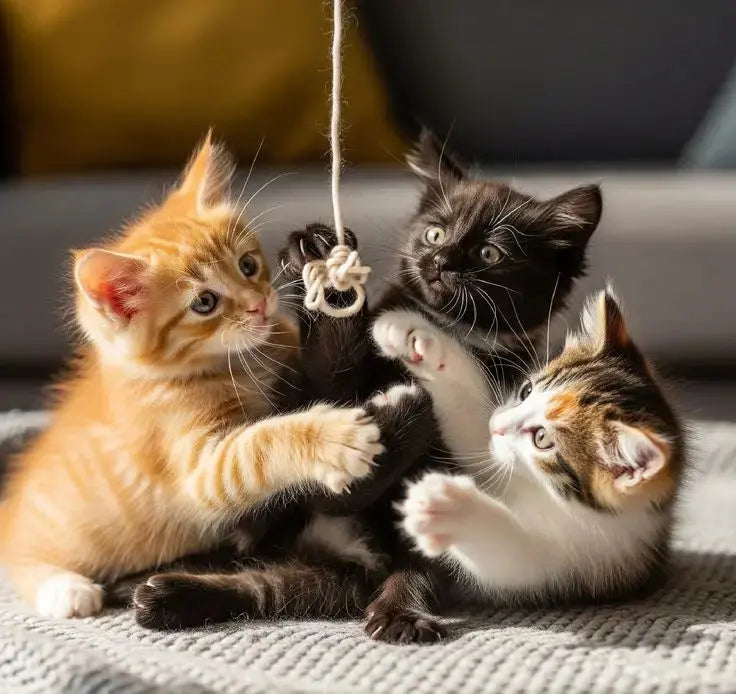
What To Read Next?

Cat Breeds in India

Cat breeds in India

Mar 10, 2026
by
Nivedita Fernandes
Persian Cat Breed

Persian Cat Breed

Mar 12, 2026
by
Nivedita Fernandes